

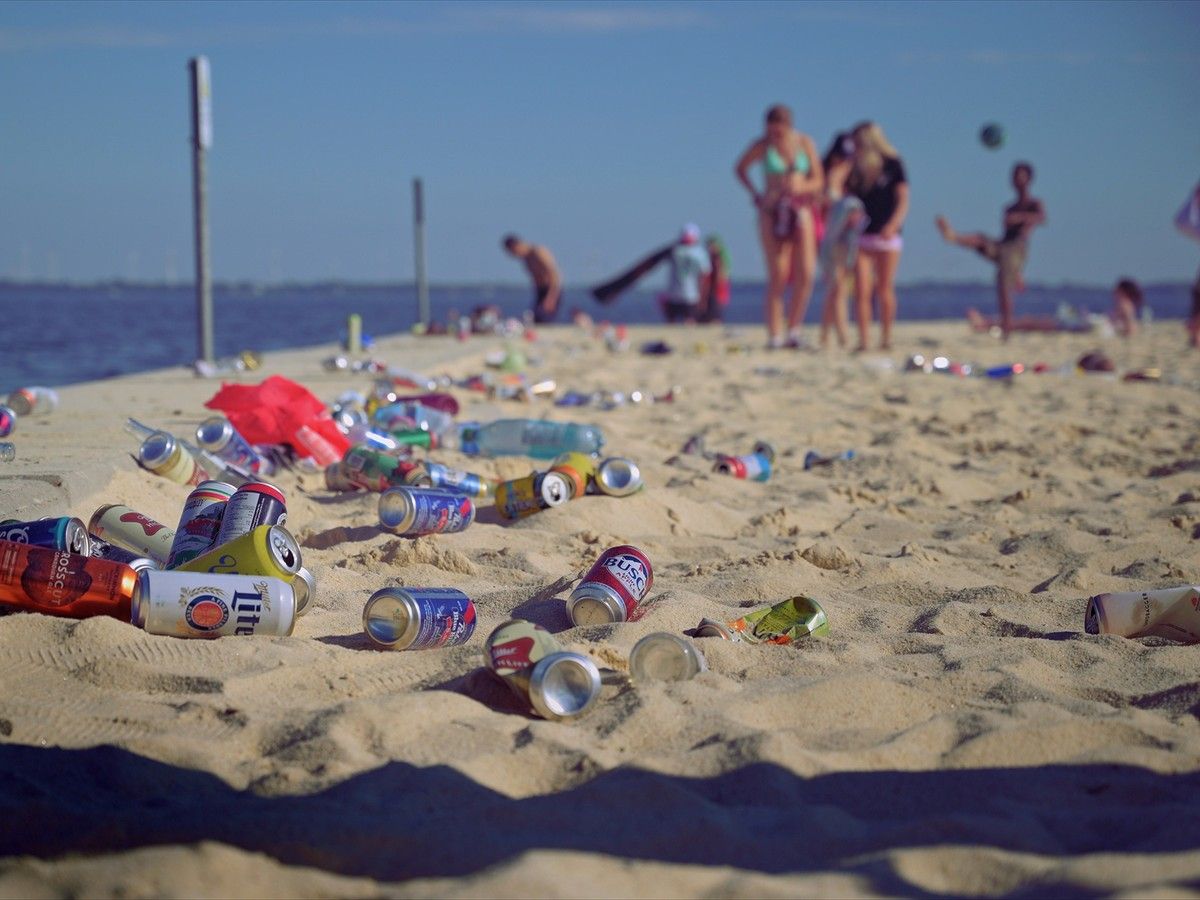
Sources say celebrating community also means cleaning up after it
Article content Approximately 1,000 people brought the party to the pier for Canada Day, but many left much of it behind. Students and Kingstonians alike gathered at the Gord Downie Pier to celebrate Canada Day earlier this month, bringing with them music and energy, but leaving behind waste, from beer cans to sunglasses. Following the national holiday festivities, there were no formal complaints made, but some took to online forums to voice their frustrations about the amount of garbage left behind after the large gatherings.
Kingstonians remain divided on how to tackle waste management after large pier celebrations — or whether there is even a problem to solve in the first place. Unsurprisingly, Canada Day certainly brought large crowds to the pier. For the city, this was business as usual.
Kingston Police media relations officer Const. Anthony Colangeli confirmed the pier was busy, estimating that footage he observed suggested upward of potentially 1,000 visitors. “Gord Pier was exceptionally busy over Canada Day weekend.
We experienced significantly higher attendance than we typically see. Just large numbers of residents and visitors gathered at the waterfront there over the holiday weekend, and then a little bit into the week, but I would say that Saturday was probably the busiest day,” he said. While officers were stationed in the area, Colangeli confirmed no tickets were issued.
“On the Saturday (June 27), we had officers present in the area just to monitor activity, engage with the public, and help ensure overall safety. But there were no significant incidents or anything over the Canada Day weekend or anything that required a specific police response,” he said. Overall, he described it as “a positive weekend.”
“Although it was large crowds, like I said, no significant issues, no misbehaving, generally well-behaved crowds. So it wasn’t a terrible thing to see. It was nice to see our city busy, and people out enjoying it.”
Troy Stubinski, operations manager for the Public Works Department of the City of Kingston, echoed similar sentiments. He said while they took some additional efforts, no official complaints were made regarding littering or noise at the pier. “We increase our check-ins, we increase our cleaning, but this is something that we anticipate and that we plan for,” he said.
“This is all normal operations for us. It’s all things that we expect and things that we know that we need to do in order to support the increased usage of the park and the pier, especially when we get weather conditions like we’ve had with Canada Day.” He added that the weekend came at no additional cost.
While staff worked until 11 p.m. on Canada Day, rather than their usual 10 p.m., this was offset by shifting their schedules rather than the addition of more hours. Stubinski also explained that while the city doesn’t track the amount of garbage that is picked up, the weekend did not impact the cost to dispose of the additional waste. Similar to Colangeli, he views the weekend as a success and feels the city is confident in its ability to handle these elevated usage periods.
“I think we have a good handle on what we need to do and how we do it, so we don’t foresee any changes,” he said. “This Canada Day was pretty normal for us and didn’t ring any red bells or red lights that we needed to change something.” However, some Kingston-based environmental groups believe that everyone involved in the festivities could do more to keep the space safe and clean.
They point to the issue being education, not infrastructure. Guillaume Courcy, co-owner of Neptune and Salacia Diving, often hosts underwater diving cleanups around Kingston. With the Gord Downie Pier, he noted that no matter how often it is cleaned, it always tends to accumulate mass amounts of waste, including hats, shoes, and beverage containers, among other things.
“(The pier) is one of Kingston’s most popular waterfront gathering places. It is easily accessible, has beautiful views, and naturally attracts large numbers of people, especially during warm weather and celebrations. When thousands of people use the same area, even if only a small percentage leave litter behind, it quickly adds up,” Courcy stated.
Similarly, Benjamin Rennie, a fourth-year geography student at Queen’s University and co-president of Queen’s Conference on Ocean Sustainability (QCOS), acknowledged the pier’s role as a “cultural landmark” for students, because of its convenient location, “incredible views” and open, welcoming atmosphere. However, he also acknowledged that “with popularity comes larger crowds, which naturally produce more waste.” “Large celebrations naturally put pressure on the area’s waste and recycling infrastructure.
When thousands of people gather in one place, even small acts of carelessness can have significant environmental consequences. Litter that isn’t properly disposed of can quickly make its way into Lake Ontario, where it becomes much more difficult to remove and can harm local ecosystems,” Rennie stated. Courcy suggested that the city supply more garbage and recycling stations during major events, as well as clear signage about protecting the waterfront.
Despite his ideas, he acknowledged that “no amount of infrastructure can replace personal responsibility.” Courcy suggested that, “before leaving (the pier), take a few seconds to make sure you have everything you brought with you and that your garbage has been disposed of properly. If something falls into the water or blows away, do not simply assume it has disappeared.”
He added that while people know littering is wrong, many do not realize how much waste accumulates under the water out of sight. “Education before and during major gatherings could also help reinforce the message. At the same time, the city cannot be expected to follow every individual and clean up after every careless decision.
Protecting the waterfront has to be a shared responsibility, and event attendees have an important role to play,” Courcy stated. On this point, Rennie agreed, stating, “infrastructure certainly matters, but education and culture are just as important. We’ve become accustomed to disposable products, and that has normalized a level of waste that often goes unquestioned.
One of QCOS’s goals is to encourage conversations about how our everyday choices affect freshwater and marine environments.” “When litter reaches the water, it doesn’t simply disappear, it becomes part of an ecosystem that many people never see. I hope students recognize that protecting our waterfront begins with individual choices,” he stated.
University students who frequented the pier on Canada Day claim to have had a positive experience, but waste management was not at the forefront of their thoughts. For Virginia Speer, a visiting undergraduate student from the University of Ottawa, spending Canada Day at the pier was an overwhelmingly positive experience. She even ran into friends she knew from her home university in Ottawa who were also visiting.
“Even as someone who does not go to Queen’s, I feel like I belong in the space. It’s a social spot and there’s an overall sense of community,” Speer said. Speer did not notice anyone being wasteful, and when she went for a nighttime pier walk with her boyfriend, she mentioned that “there was no trace of the large crowd that was there all afternoon.”
While celebrating at the pier, Speer did note that there were a minimal number of easily accessible garbage cans, but she prefaced that “students should pick up any trash left behind regardless of whether it belonged to them, because everyone has to play their part in keeping the community and the environment clean.” For Kieron Luke, a fifth-year undergraduate Queen’s student, Canada Day was a great time to relax and catch up with friends. He mentioned he’s seen students be wasteful, but overall thinks it’s a “minor inconvenience.”
Despite this, Luke encouraged students to “make a larger effort to clean up after themselves because it is a privilege to be able to use the pier for moments like Canada Day. It’s a gift and we should be grateful for the great time and the great space.” Whether the city needs more bins, more education, or no changes at all remains up for debate.
While opinions differ on whether the amount of litter left behind at the pier warrants any changes to pier celebrations in general, most seem to agree that these celebrations, like Canada Day, are worth having, but keeping the environment clean is a shared responsibility. “These celebrations are worth having, but they should also come with stronger public awareness and a greater expectation that everyone cleans up after themselves. We should be able to celebrate without leaving the waterfront in worse condition than we found it,” Courcy stated.
- Published
- Jul 16, 2026
- Updated
- Jul 16, 2026
- Source
- The Kingston Whig Standard
- Category
- Domestic
- Read time
- 6 min
Key facts
Why this matters locally
This domestic story matters locally because it may affect readers, businesses, commuters, families, or public services in British Columbia.
Local impact
BC Post links this item to British Columbia coverage so readers can follow related city updates, weather, traffic, events, and category news in one place.
Timeline
Source and credit
BC Post may summarize, organize, and add local context for reader clarity. Original reporting remains with the listed publisher.
Related Articles
View all Domestic
BC’s Macklin Celebrini is INHF’s Male Player of the Year
Domestic
BC’s Macklin Celebrini is INHF’s Male Player of the Year
 Domestic
More CCTV cameras installed in Cambridge, North Dumfries
Domestic
More CCTV cameras installed in Cambridge, North Dumfries
 Domestic
Elections Alberta wants 'spoof' website with fake voter info taken down
Domestic
Elections Alberta wants 'spoof' website with fake voter info taken down
 Domestic
Montreal police investigate torched vehicle in Rivière-des-Prairies
Domestic
Montreal police investigate torched vehicle in Rivière-des-Prairies
 Domestic
Don’t sleep while you are driving, Mounties remind public
Domestic
Don’t sleep while you are driving, Mounties remind public
 Domestic
Tornadoes in Alberta already up more than 50 per cent from last year
Domestic
Tornadoes in Alberta already up more than 50 per cent from last year
More Local Coverage
Latest news Business
AI Market Trends: Q2 2026 Review and Forecast
Business
AI Market Trends: Q2 2026 Review and Forecast
 Politics
Powerful pro-life ad featuring boxing legend to air during final World Cup matches
Politics
Powerful pro-life ad featuring boxing legend to air during final World Cup matches
 Local News
Cowichan sports shorts: rugby, hockey, biking
Local News
Cowichan sports shorts: rugby, hockey, biking