

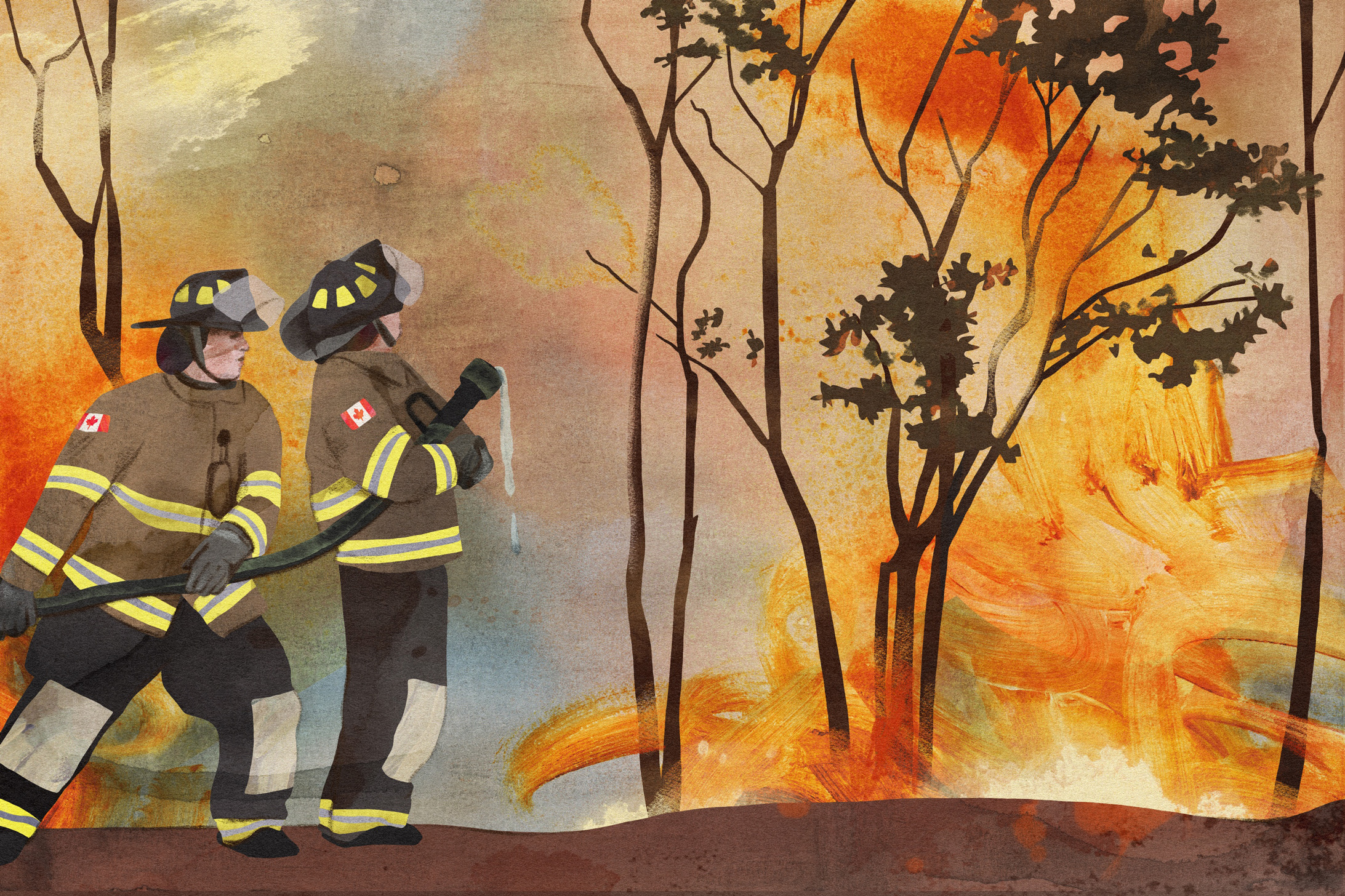
The country still lacks the people and equipment to handle our record-breaking wildfires The post Canada Is Primed to Burn. Why Aren’t We Ready? first appeared on The Walrus .
At 7:02 p.m. on July 22, 2024, a lightning bolt ignited a small fire less than five kilometres north of Jasper’s town centre. Minutes later, a series of lightning strikes sparked three more fires about forty-five kilometres south of the Alberta town. Key points - Wildfire seasons are getting hotter, longer, drier, and using up more firefighting resources - Establishing a centralized, national body for wildfires could ensure Canada has a united, consistently funded approach to fire management - Experts encourage deprioritizing fire suppression and post-fire response in favour of investment in mitigation and prevention Landon Shepherd, Parks Canada’s wildfire incident commander for Jasper National Park and a vegetation specialist, was swimming at nearby Edith Lake with his wife when he saw a helicopter with a bucket fly overhead.
He texted a member of his team, asking if he should come in. “Yes,” came the reply instantly. Over the next hours, the south fires merged into a single inferno, spreading rapidly along the tree crowns.
Shepherd made some calls, but all water bombers across the province and in neighbouring British Columbia were in use fighting other fires. That night, the town of 5,000 people was evacuated, including Shepherd’s wife and two kids. In the following days, more firefighters arrived from Alberta, BC, Ontario, and Yukon.
But it quickly became clear that the fire was slipping out of control. “I started thinking, this is going to be a multi-casualty incident,” says Shepherd. “We have too many people, the conditions are too extreme . . .
I don’t think we’re going to get away lucky.” By the time air support arrived that same day, the blaze was so big they were unable to make a dent, and neither could the ground crews. As the south fire crept up the mountainside toward the town, it created its own weather system, with dense black pyrocumulonimbus clouds generating 200-kilometre-per-hour winds and making the fire less predictable.
By July 24, the fire had reached Jasper valley, and the column collapsed, spraying smoke and embers onto the outer limits of the town and igniting buildings. As the day came to an end, 358 structures had been lost, and one firefighter, Morgan Kitchen, was dead. Soon after the last embers were extinguished, questions began surfacing: How did this happen?
If a fire can burn a third of the town of Jasper, what does the future hold for the rest of the country, much of which also lies in fire’s path? And, crucially, is there anything we can do to stop it? Wildfire seasons, amplified by climate change, are getting hotter, longer, and drier, and Canada’s resources are buckling under the weight of the number and scale.
In the last three years, Canada has spent more days at National Preparedness Level (NPL) five—the highest, meaning domestic resources are maxed out—than in the combined years of the decade before. “I’ve been talking about fire and climate change since the mid ’80s, and this is catching me off guard,” says Mike Flannigan, a fire expert with Thompson Rivers University. Flannigan says fire has surprised him a few times over the years, jumping farther and burning faster, but the situation today has him flummoxed—some of the numbers he’s seeing now, in terms of area burned, he and his colleagues weren’t expecting until the end of the century.
Jasper falls second in Canada’s most expensive wildland fires, behind the 2016 Fort McMurray fire, nicknamed “The Beast,” that burned 2,400 homes and cost the federal government more than $4 billion, including $3.6 billion in insurance damages. A decade ago, destructive fire seasons were seen as flukes—until 2023, the worst fire season in Canada’s history. That year was followed by two more extreme fire seasons.
All told, 8 percent of Canada’s forests have burned in the last three years, which works out to be about 4 million hectares a year—four times the rate in the 1970s. This summer, with the combination of a “Super El Niño” and persistent drought on Canada’s West and East Coasts, scientists are predicting high intensity wildfires across the country—and particularly in the west. Flannigan has taken to calling 2026 a litmus test.
“We’ve never had three bad years in a row. We’ve had two bad years . . . but never three.
And this is why, in 2026, if we get another bad fire year, it’s like—” Flannigan makes an explosion with his hands. Canada divides its wildfire-fighting responsibilities among provinces and territories, with a federal division for parks. How each agency manages its fires varies—Yukon, for example, lets most of its fires burn, jumping in only when they get close to urban areas, whereas BC and Alberta try to suppress the majority of fires wherever they are.
Budgets and staffing are also decentralized, with each province and territory owning and contracting out their own firefighters and fleets of air tankers as needed. In the 1980s, the provincial agencies and federal government jointly created the Canadian Interagency Forest Fire Centre (CIFFC) to coordinate information and resource sharing between regions. When one area needs help battling a fire, it can request support from other provinces through CIFFC, which keeps tabs on which regions have firefighters and planes to spare.
But the centre only has so much to work with. “The fact that we are seeing more and more years where we are at an NPL four and five is a strong indicator that certainly the need for resources isn’t going down,” says Mike McCulley, director of operations at CIFFC. “No agency really has that ability to staff up for the absolute worst chaos.
And I don’t know if we’ve even seen the worst chaos yet.” When every wildfire fighter within Canada is deployed (NPL 5), CIFFC turns to countries like Australia, Mexico, and South Africa for help, a backstop that Canada has been increasingly leaning on. Between 2015 and 2022, the most international firefighters in Canada at any time was 785, with a yearly average of 350.
In 2025, that number was 1,279. Two years before, during 2023’s record-breaking year for wildfire, it was 4,464. Apart from partially funding CIFFC, the federal government also manages national parks (such as Jasper) and co-manages Crown land with provinces and territories.
It also divvies up grants for fire research, training, and mitigation projects among agencies and municipalities, which equalled $47.8 million for 2026. But some want it to be doing more. In an open letter to Prime Minister Mark Carney ahead of the November 2025 federal budget, an alliance of groups including the Council for Clean Capitalism and the Canadian Association of Fire Chiefs requested a “national resilience package” worth $4.1 billion over five years and the creation of a National Fire Administration.
The ideas in the letter were not new. A centralized, national body could make sure the country has a united and consistently funded approach to prevention and suppression, say advocates. Rather than coordinating scattered resources and personnel across jurisdictions with their own priorities and budgets, like CIFFC, it would have its own.
They believe that if wildfire management was integrated into other national-priority areas like housing, infrastructure, green technology, health, and employment, there would be fewer gaps in resources and decision making. Currently, Canada is the only G7 country that does not have a national agency to respond to wildfire. After the devastating 2023 fire season, then BC member of Parliament Richard Cannings called on the government to establish a national, non-military forest fighting force to be deployed when needed to support provincial teams.
This prompted a survey by Abacus Data, which polled 1,500 Canadians and found that three in four are in support. An analysis of the data suggested that summer’s fires “left a lasting impression on the public consciousness, emphasizing that wildfires are not isolated incidents but a national problem requiring a national solution.” Fire needs three things: fuel, ignition, and the right conditions.
While it’s a natural process and part of a healthy ecosystem, as humans alter the climate and conditions for burning, fire’s relationship with the landscape is shifting. “Up until 2023, whenever we talked with the media and other people about the role of climate change and fire, we were very conservative in what we said as scientists . . . we were leaving room for uncertainty,” says Piyush Jain, a research scientist with the Canadian Forest Service.
“I sensed the real change in tone in 2023.” Warmer temperatures suck moisture from vegetation, creating situations where forests are bone dry and primed to burn. When it comes to ignition, half are caused by human activities—campfires, ATVs, power lines—while the other half are caused by lightning strikes.
(In part due to widespread public campaigns like Smokey Bear, human-caused ignition has decreased over the last few decades.) When ignition occurs, hot, dry, and windy weather can turn a smouldering fire into an inferno, and a volatile climate is making it more difficult to know what’s coming year to year. “Fire weather, now that’s hard to predict,” says Jain.
Understanding of fire danger “is only as good as the weather models that go into predicting it.” This means typically only a couple months in advance at the most, he says. Climate models, on the other hand, can be useful at understanding weather patterns associated with climate change, but they also have limitations.
“They tell you the type of climate we’re going to have in fifty years. They don’t tell you the weather you’re going to have in fifty years,” says Jain. He uses a combination of both weather and climate models, looking at large-scale patterns like high-pressure systems or drought.
He also points to the recent introduction of artificial intelligence to enhance traditional forecasting, which will take historic data to make projections more accurate. Despite improvements in technology and instruments, increasingly unpredictable weather systems have created a moving target for meteorologists. Most often an ensemble of models is used, and incorporates a combination of factors, including humidity, lightning, temperature, precipitation, and wind.
Some trends are clear. According to recent studies, the number of fires is decreasing, but those that do burn are more intense and destructive than ever before. Today about 3 percent of wildfires in Canada account for 97 percent of the area burned.
Those are the big-problem fires: the Fort Macs, the Slave Lakes, the Jaspers, the Lyttons. “What is of concern is how fire danger is increasing because of climate change, but also how it’s coming up against what we call the ‘wildland–urban interface,’” says Jain. Humans are building infrastructure, structures, and homes deeper into the forest.
Canada’s East Coast, where wildfires are becoming increasingly common, has the highest densities of interface. Last summer, conditions in some Atlantic provinces were so bad they forced a shuttering of forests, including Crown and private lands, with fines reaching $150,000 or jail. But even far removed from the wildland–urban crossover, wildfires can have knock-on effects for millions of people.
“Smoke is bad across the board, and I don’t think we really know how bad it is,” Flannigan says. One Canada-wide study that analyzed the impact of wildfire smoke on human health between 2019 and 2023 found that acute exposure causes hundreds of premature deaths and costs the country up to $3.6 billion a year. All that burning leads to some shocking statistics.
Until the 1990s, Canada’s forests acted as carbon sinks, but in recent decades, this has reversed, and today, forests across the country are releasing more carbon into the atmosphere than they’re accumulating. Sustainability research group Corporate Knights has calculated the number to average 600 million tonnes annually. In 2023, Canada’s wildfire season released the equivalent of the annual fossil fuel emissions of India.
So how much is in our control? Despite fire being natural to the landscape, there is nothing natural about how Canada has managed its forests in the last century. Most regions in Canada are prone to periodic burning, but rather than let natural fires burn up carbon-storing undergrowth and trigger renewal and nutrient cycling, it’s become our habit to fear and suppress, leaving forests overgrown with fuel and vulnerable to sparks.
Overall, parks in particular have been kept in good condition. Prior to the formation of Jasper National Park in 1907—then called Jasper Park National Reserve—the region burned every half century, frequently helped by Indigenous people. This is what Amy Cardinal Christianson, the senior fire analyst for the Indigenous Leadership Initiative and a former research scientist with the Canadian Forest Service, calls “good fire.”
When the Jasper wildfire ignited in 2024, the park hadn’t seen regular fire in over a century. Overgrown vegetation creates what some call “ladder fuels,” allowing fire to climb from the ground to the crowns and building into a high-intensity blaze that neither air tankers nor ground crews can extinguish. “These are not the fires of a hundred years ago where they were occurring in healthy landscapes and regenerating,” says Cardinal Christianson.
“These are fires in unhealthy forests in an era of climate change.” For this reason, calls from all corners and angles for better fire management and shifting the focus from suppression to mitigation has risen in recent years to a chorus. In a 2024 report, the Canadian Council of Forest Ministers stated that “Suppression alone is no longer adequate to address the growing challenges from wildland fire.
Wildland fire management in Canada needs to be transformed.” According to Canada’s government website, Parks Canada conducted fifteen prescribed fires across national parks last year. (Parks Canada had done four prescribed burns in Jasper in the year leading up to the fire.)
Provinces also regularly do intentional burns, with CIFFC data putting the number at eighty-four fires in 2024, though these activities are sporadic and grant-based, coming from a patchwork of funding streams including the federal Disaster Mitigation and Adaptation Fund. Created in 2018 to help communities become more resilient to climate change, the fund’s initial budget was $2 billion over ten years, but under the weight of so much need in 2021, this was topped up with an additional $1.3 billion over twelve years. Bob Gray, a fire ecologist, is pushing for more investment in mitigation, which includes prescribed and cultural burning on a large scale.
“We’ve done the science. We know what needs to get done on the landscape, but that still comes with a price tag.” Like others, he points to 2023 as a year that woke people up but senses many people are still reluctant to invest money into forward planning.
“The longer we wait, the more consequences there will be,” he says. “Kicking the can down the road, it just isn’t going to work.” Gray, who started his career as a hotshot crew member for the United States Fire Service, gave testimony to the senate on wildfire management in October 2025, where he asked senators on the Agriculture and Forestry standing committee to pivot funding from suppression to forward planning, which includes forest thinning, cultural and prescribed burning, and post-fire restoration.
In June, the committee published a report detailing the scale and effects of wildfires in Canada. In the report, the senators highlighted the country’s fractured jurisdictions and coordination challenges as barriers to response and access to firefighters and equipment. It also listed fifteen recommendations, namely a “federal coordinating office” modelled after countries like the US and Australia and long-term investment for landscape-level planning, training, and capacity building.
For Gray, the recommendations were disappointing, focusing too much on response and not enough on mitigation. “The whole reason behind the project was to address the threat of wildfire to forestry and agriculture,” he said in an email. “I don’t know how you read the recommendations and come away with any clear plan to do just that.”
The question of consistent funding is top of mind for many fire experts. Recent local and national budget cuts have limited Canada’s ability to fight fires, creating a reactive response rather than encouraging forward planning to prevent them in the first place. In the 1990s, the federal government shrank the Canadian Forest Service from 2,200 to 700, leading to reduced research and forest management.
“I’ve been in the fire business since the ’70s, and at times, you felt like a voice in the wilderness, saying we need more money for fire,” says Flannigan. He says this changed after Fort McMurray, when the government realized the need for more research and mitigation. “Sometimes it takes a few bloody noses before things change.”
Decentralized jurisdictions make it difficult to create a coordinated funding strategy for forest management and wildfire preparedness, however. In 2025, Ontario premier Doug Ford decreased the province’s budget for emergency forest firefighting from $177 million to $135 million, with $4 million cut from emergency preparedness. According to the budget, the province ended up spending $271 million—double.
This year, the province earmarked $150 million. Similarly, Saskatchewan’s 2026 budget, announced in March, fell well short of what the province needs to combat wildfires. It allocated around $140 million, which, despite being a $20 million increase from the year before, is far below the $392 million the province spent last year fighting the fires.
“Hopefully, we don’t have the kind of year we had last year,” the province’s finance minister told the CBC at the time. With regards to BC, Gray also points to the uneven nature of contingency funds, where just-in-case money is added to a pot for anything from natural disasters to pandemic-related emergencies. In 2024, $10.5 billion in contingency money was earmarked over three years, with a specific note for wildfire response, but Gray says this could be going to mitigation efforts.
“It’s constant response and recovery,” he says. “More and more money to react versus investing more to get ahead of it.” While there is no pan-Indigenous approach, burning sections of forest or grassland has been a traditional land-management practice since before colonization.
After European contact, fire was regularly suppressed in favour of preserving lumber. “Before colonization, our knowledge systems had to be adaptive to what happened on the land because we were so reliant on the land to keep us alive,” says Cardinal Christianson. “If the land wasn’t healthy, we would die.”
Cardinal Christianson’s work focuses on Indigenous fire stewardship and forest resiliency in Canada, and she advocates for more allowance for cultural burning practices across Canada and, ultimately, greater trust in these knowledge systems. She says most communities do spring and fall burning, mostly for cultural objectives, such as to revitalize food and medicinal plants or habitat for game, but “a side benefit is that it reduces their fire risk,” she says. Without special permissions, the practice is illegal, and Cardinal Christianson says many communities do it in secret.
The federal government does partner with some First Nations, such as the Blood Tribe or Kainai Nation in Alberta, which became the first fire guardians program in Canada in March 2025. Last August, Canada promised $45.7 million in research grants to better understand and mitigate fire risks, a third of which will go to Indigenous-led projects. These grant-led initiatives feel temporary and uneven, says Cardinal Christianson, and too few to be impactful.
Both Cardinal Christianson and Gray believe Canada should invest in local and regional solutions rather than fly in firefighters from other countries. Employing local firefighters year-round would ensure a stable workforce that would train and plan over the winter and carry out prescribed or cultural burns in the shoulder seasons. But CIFFC’s Mike McCulley says it’s more complicated than just hiring and training more wildfire fighters—provinces and municipalities each have legal jurisdiction.
Plus, he appreciates people want to step up in their regions, but they have to be trained and supported. “It’s not as simple as people think,” he says. “Ready, willing, and able might be quite different than what the law or the standard or the agency’s requirement is.”
Three hundred kilometres south of Jasper is the small town of Canmore, nestled in the Rocky Mountains an hour’s drive from Calgary. In March, islands of soft snow melt and reveal patches of pavement and brown grass, while a low blanket of cloud cover hides the tops of mountains. It may not feel like it, but fire season has already begun.
In the snowy band of forest surrounding the town, yellow Tigercat fellers cut lodgepole pine and spruce trees, slowly clearing the area. By summer, eighty-two hectares of forest will be harvested and cleared in the areas east and west of the town, with an additional thirty-five hectares thinned. Canmore was already working on its fireguard program when a third of Jasper burnt down in 2024, but since then, public buy-in has been easier.
“When you’re cutting down large sections of trees, that can be really hard for some folks,” says Caitlin Miller, the town’s director of emergency management. “They don’t understand that hundreds of years of wildfire suppression has made it so that we’ve put ourselves more at risk.” The fire break will slow a wildfire before it reaches town, but this year, residents are also clearing branches and debris from their own yards and gutters.
Today, 600 homes in Canmore are part of a nationwide FireSmart program, which helps communities reduce wildfire risk. The program is the last line of defence for many communities. “Fire enters communities typically through a rain of embers, little burning bits of twig, bark, sometimes pine cones,” says Flannigan.
“So look at the community; this is where gains can be made.” As Jasper rebuilds, an updated by-law requires new structures to be resilient to fire, which includes creating a 1.5-metre buffer zone of non-flammable materials (like gravel or concrete) and limitations on building materials such as wood siding and cedar shakes on roofs. For the rest of the town, however, the upgrades are optional.
The problem, says Flannigan, is it only takes one chink in the armour. “Either all are FireSmart or it doesn’t work,” he says. When the forests are on fire and the embers reach the neighbourhood, you’re only as strong as your weakest link.
On April 1, 2026, expert voices from the health, climate, policy, and technology sectors came together to explore the impact of the wildfire crisis at The Walrus Talks Wildfires. A recording of this presentation is available to watch here.
- Published
- Jul 10, 2026
- Updated
- Jul 11, 2026
- Source
- Thewalrus Ca News
- Category
- Weather
- Read time
- 17 min
Key facts
Why this matters locally
This weather story matters locally because it may affect readers, businesses, commuters, families, or public services in British Columbia.
Local impact
BC Post links this item to British Columbia coverage so readers can follow related city updates, weather, traffic, events, and category news in one place.
Timeline
Source and credit
BC Post may summarize, organize, and add local context for reader clarity. Original reporting remains with the listed publisher.
Related Articles
View all Weather
Markets don’t care what you paid: The dangers of getting too attached to a stock
Weather
Markets don’t care what you paid: The dangers of getting too attached to a stock
 Weather
BRUCE MACTAVISH: Rare birds and plentiful food sources a boon for birdwatchers
Weather
BRUCE MACTAVISH: Rare birds and plentiful food sources a boon for birdwatchers
 Weather
Welcome to the climate emergency, Kingston
Weather
Welcome to the climate emergency, Kingston
 Weather
Calgary weather: Daytime highs in the high 20s for most of this week
Weather
Calgary weather: Daytime highs in the high 20s for most of this week
 Weather
7 'coolcation' destinations around the world to beat the summer heat
Weather
7 'coolcation' destinations around the world to beat the summer heat
 Weather
'No happy medium': Cape Breton farms adapt to weather extremes
Weather
'No happy medium': Cape Breton farms adapt to weather extremes
More Local Coverage
Latest news Business
AI Market Trends: Q2 2026 Review and Forecast
Business
AI Market Trends: Q2 2026 Review and Forecast
 Politics
Powerful pro-life ad featuring boxing legend to air during final World Cup matches
Politics
Powerful pro-life ad featuring boxing legend to air during final World Cup matches