

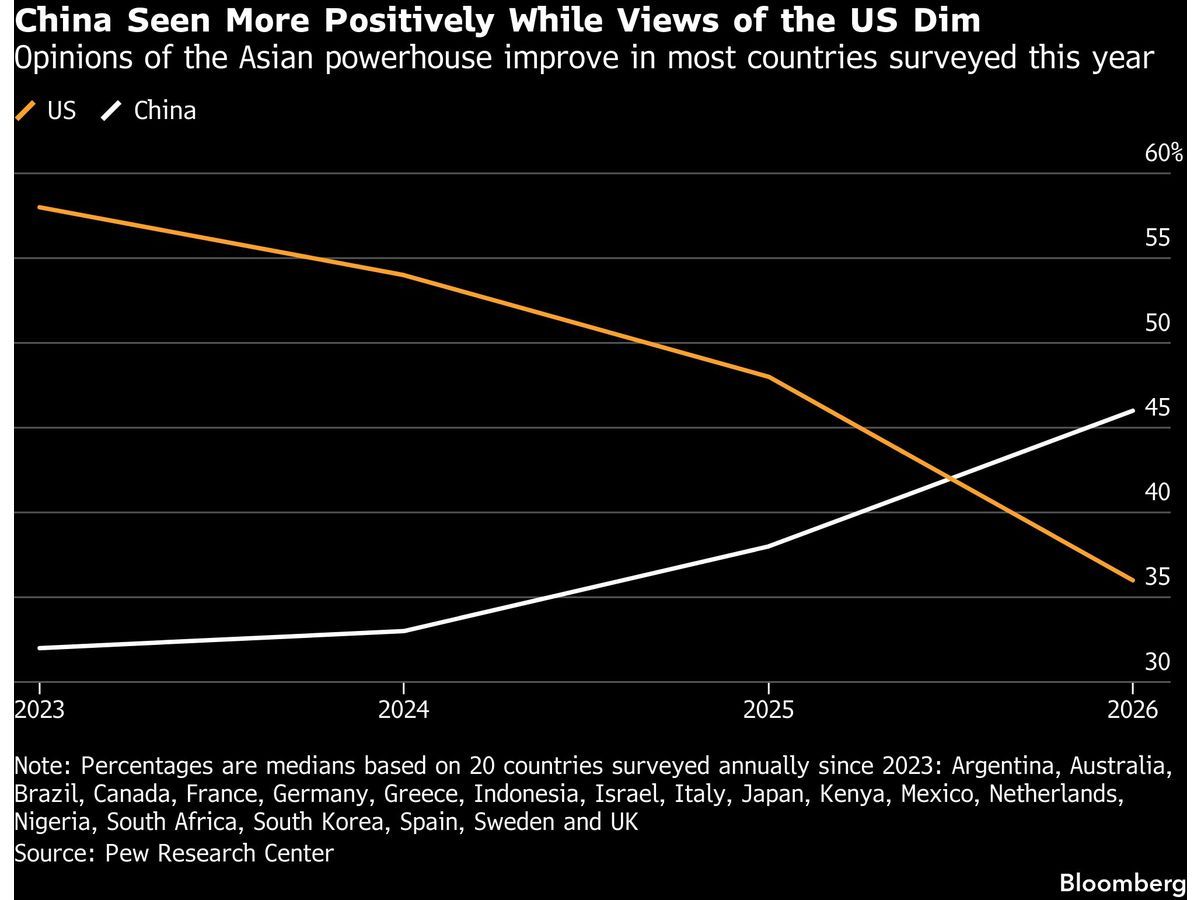
More people around the world view China more positively than the US for the first time since at least 2023, according to a survey by Pew Research Center, with sentiment shifting even among some of Washington’s allies as the two powers compete for influence globally.
(Bloomberg) — More people around the world view China more positively than the US for the first time since at least 2023, according to a survey by Pew Research Center, with sentiment shifting even among some of Washington’s allies as the two powers compete for influence globally. Public opinion of the US has worsened to the extent that China is now seen more favorably in most of the 36 countries surveyed this year.
Those include Canada, Australia, France and Germany — US allies where the “favorability gap” with Beijing has reversed in recent years. In 20 countries with comparable data going back to 2023, nearly half held a positive view of China, while only 36% regarded the US favorably. That’s a significant reversal from three years ago, when the US scored 58% against China’s 32%.
It also marks a rebound for Beijing after its rating hit historic lows in many countries during the Covid-19 pandemic. “Global views of the United States worsened last year as President Donald Trump’s second term began, though most people still had a more positive opinion of the US than China,” according to the report released Wednesday afternoon, Washington time. “This year, that is no longer the case.”
One area where the US continues to get better ratings than China is its respect for personal freedom, with more respondents saying Washington respects individual liberties. However, that gap is also narrowing. Pew Research surveyed more than 42,000 people from February 8 to May 13, a period that includes the start of the US-led war in Iran.
As the conflict dragged on and threatened to disrupt the global economy, Beijing sought to portray itself as a stabilizing force. President Xi Jinping also signaled his ambition for China and its ruling Communist Party to stand at the forefront of global affairs. At the same time, Trump has shaken traditional US alliances and ignored established diplomatic practices in favor of a transactional approach.
His tariff policy and threats to annex territories such as Greenland have alienated even some of America’s closest partners. China’s edge over the US is particularly significant in several Asia-Pacific and Middle Eastern nations, according to the survey. Only six countries — India, Japan, the Philippines, South Korea, Israel and Poland — viewed the US more positively than China among the larger group of 36 countries surveyed this year.
A separate Pew report focusing on China shows that favorable views of the world’s second-largest economy are at or near record highs in a number of countries, including some in Europe. Pew also found that confidence in Trump and Xi to do the right thing regarding world affairs has followed a similar pattern. While global views of both leaders are generally negative, Xi’s favorability has overtaken Trump’s.
Confidence in the US leadership has been steadily declining since at least the latter half of Joe Biden’s presidency, according to the study. On foreign policy, respondents in 17 middle-income nations raised more concerns about the US than China. More in those countries see China as “a reliable partner” than the US and say China contributes “a great deal” or a “fair amount” to peace and stability around the world more than the US.
Other survey findings: - Younger respondents tend to have more positive views of China than older people in most of the surveyed countries. - Americans’ closest neighbors, Canada and Mexico, view China more positively than the US. - In several nations neighboring China — India, the Philippines and Japan — Trump has higher ratings than Xi. -
Many in Latin America are divided over whether the US or China is a more reliable partner.
- Published
- Jul 15, 2026
- Updated
- Jul 15, 2026
- Source
- Financial Post
- Category
- Politics
- Read time
- 3 min
Key facts
Why this matters locally
This politics story matters locally because it may affect readers, businesses, commuters, families, or public services in British Columbia.
Local impact
BC Post links this item to British Columbia coverage so readers can follow related city updates, weather, traffic, events, and category news in one place.
Timeline
Source and credit
BC Post may summarize, organize, and add local context for reader clarity. Original reporting remains with the listed publisher.
Related Articles
View all Politics
Powerful pro-life ad featuring boxing legend to air during final World Cup matches
Politics
Powerful pro-life ad featuring boxing legend to air during final World Cup matches
 Politics
Vaughn Palmer: David Eby's slow and expensive step toward involuntary care
Politics
Vaughn Palmer: David Eby's slow and expensive step toward involuntary care
 Politics
Pitt Meadows to host information session for city council candidates
Politics
Pitt Meadows to host information session for city council candidates
 Politics
Hundreds of enthusiatic supporters attend Surrey Mayor Brenda Locke’s fundarising dinner
Politics
Hundreds of enthusiatic supporters attend Surrey Mayor Brenda Locke’s fundarising dinner
 Politics
Funding local governments to speed up delivery of homes
Politics
Funding local governments to speed up delivery of homes
 Politics
Randhawa slams 2nd ‘questionable’ land purchase by City of Surrey
Politics
Randhawa slams 2nd ‘questionable’ land purchase by City of Surrey
More Local Coverage
Latest news Business
AI Market Trends: Q2 2026 Review and Forecast
Business
AI Market Trends: Q2 2026 Review and Forecast
 Local News
Cowichan sports shorts: rugby, hockey, biking
Local News
Cowichan sports shorts: rugby, hockey, biking