

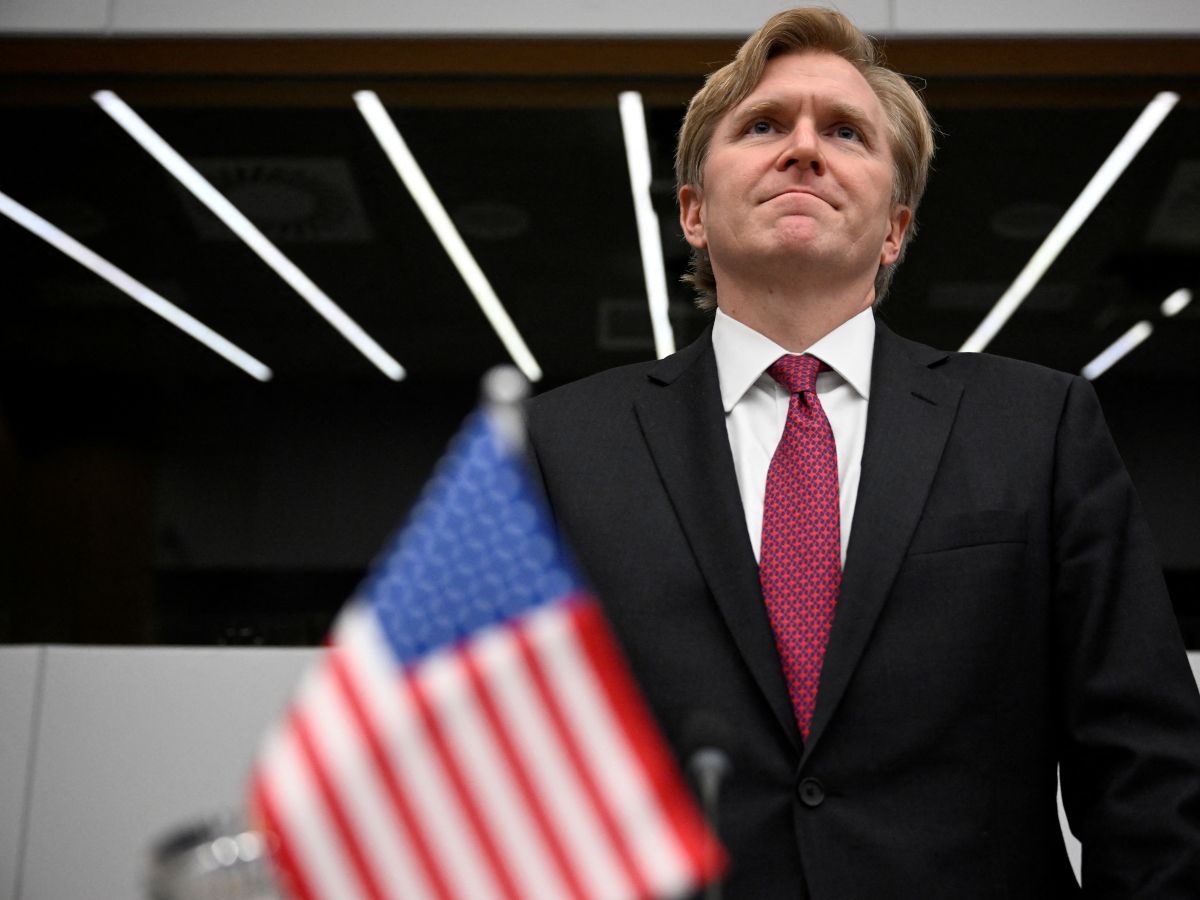
The under-secretary of war launched a direct attack against Carney’s talk of pragmatic detachment from an increasingly unreliable U.S.
Do you suppose it’s a sign of Twitter/X’s continued indispensability that the American government is communicating foreign-policy doctrine on the bird site? Or is the U.S. under-secretary of war using lowly Twitter to criticize Canada’s prime minister as a gesture of snide contempt? On Tuesday, Elbridge Colby, President Donald Trump’s top policy architect in the re-branded Department of Defence, tweeted out a multi-tweet retort to what he describes as “current hubbub about a collective ‘middle powers’ strategy.”
There can’t be any possible confusion about who he’s addressing here: this is a direct, if belated, reaction to Prime Minister Mark Carney’s talk of pragmatic, co-ordinated international detachment from an increasingly unreliable United States. Colby’s message is: this won’t work. He highlights the inherent productivity and technological supremacy of the American military-industrial complex, and suggests that “no alternative country or countries can compete with the U.S. defence industrial base, either in quantity or quality.”
Colby, who wears the label of foreign-policy “realism” like a sheriff’s badge, advises the other countries in the free world that they must not squander “time, money and political capital” on greater military independence from the U.S. — while emphasizing, in this and other settings, that America is now being governed on gol-durned America-first principles and is finished being the chief guarantor against threats to the sovereignty of distant democracies. Honestly, nothing could be better designed to make one see the merits in Carney’s otherwise non-specific and perhaps questionably practical grand strategy.
Tapping the “realism” sign, Colby attests that “middle powers don’t have a coherent basis for alignment.” This might be mistaken for an appeal to political values, or shared ideals, but it immediately follows a claim of hard-nosed and unromantic selfishness: “we view the international scene through the prism of interest, geography, economics, military power, etc.” Colby writes that “Under President Trump’s leadership, countries not only see the value of American engagement, they can no longer take it for granted.”
But isn’t that sort of the same claim that underpins Carney’s strategic philosophy, such as it is? Yeah, pal, we know we can no longer take the U.S.’s Atlanticist foreign-policy orientation for granted: it’s been beaten to hell and back by, among other intellectuals, Elbridge Colby. That’s why liberal-democratic “middle powers” in Europe and Asia probably do need to co-operate more, invest more in their own defence bases and behave as if we may need to deter collectively against Russia, China and other possible threats, without presumptive leadership or even participation from the United States.
Colby catcalls the “middle powers” for thinking they can compete with the United States, but this seems a little like missing the point — if the real goal of the Carney Doctrine is for the middle powers to be able to act in concert without the United States. No, we do get it, Mr. Colby: you’re the spokesman for the acknowledged global hegemon, and our own sovereignty probably does depend on whatever is left of anti-imperialist, properly republican sentiment in the American electorate. In short, on American goodwill.
It is not so much that we think we can build a global alliance capable of fettering the United States, but that we should be able to defend some shreds of international order and political liberalism on our own — to help protect eastern (and western) Europe from Russia, or Japan and Korea from China, without American help or extreme dependence on American arms or any presumption of American friendship. After all, how the hell else are we to react to what Colby dismisses as “alleged frustrations with the United States”?
Just the other day I must have spent a couple of hours reading about the U.S.’s corrupt revision of the deal over the Gordie Howe bridge, and about the bizarre possibility that Canadians driving Chinese electric cars might be turned aside at the U.S. border. The frustrations are pouring down on our heads like the monsoon: ordinary neighbourliness is already something we have learned not to take for granted, though we would welcome its eventual return.
- Published
- Jul 17, 2026
- Updated
- Jul 17, 2026
- Source
- National Post
- Category
- Politics
- Read time
- 3 min
Key facts
Why this matters locally
This politics story matters locally because it may affect readers, businesses, commuters, families, or public services in British Columbia.
Local impact
BC Post links this item to British Columbia coverage so readers can follow related city updates, weather, traffic, events, and category news in one place.
Timeline
Source and credit
BC Post may summarize, organize, and add local context for reader clarity. Original reporting remains with the listed publisher.
Related Articles
View all Politics
Powerful pro-life ad featuring boxing legend to air during final World Cup matches
Politics
Powerful pro-life ad featuring boxing legend to air during final World Cup matches
 Politics
Vaughn Palmer: David Eby's slow and expensive step toward involuntary care
Politics
Vaughn Palmer: David Eby's slow and expensive step toward involuntary care
 Politics
Pitt Meadows to host information session for city council candidates
Politics
Pitt Meadows to host information session for city council candidates
 Politics
Corus rebuts misinformation about future of Global News in Alberta after layoffs
Politics
Corus rebuts misinformation about future of Global News in Alberta after layoffs
 Politics
‘No consequences’: East Van woman says she was targeted by hate-motivated assault
Politics
‘No consequences’: East Van woman says she was targeted by hate-motivated assault
 Politics
Hundreds of enthusiatic supporters attend Surrey Mayor Brenda Locke’s fundarising dinner
Politics
Hundreds of enthusiatic supporters attend Surrey Mayor Brenda Locke’s fundarising dinner
More Local Coverage
Latest news Business
AI Market Trends: Q2 2026 Review and Forecast
Business
AI Market Trends: Q2 2026 Review and Forecast
 Local News
Cowichan sports shorts: rugby, hockey, biking
Local News
Cowichan sports shorts: rugby, hockey, biking