

'That not a single commissioner has resigned based on their conscience is embarrassing'
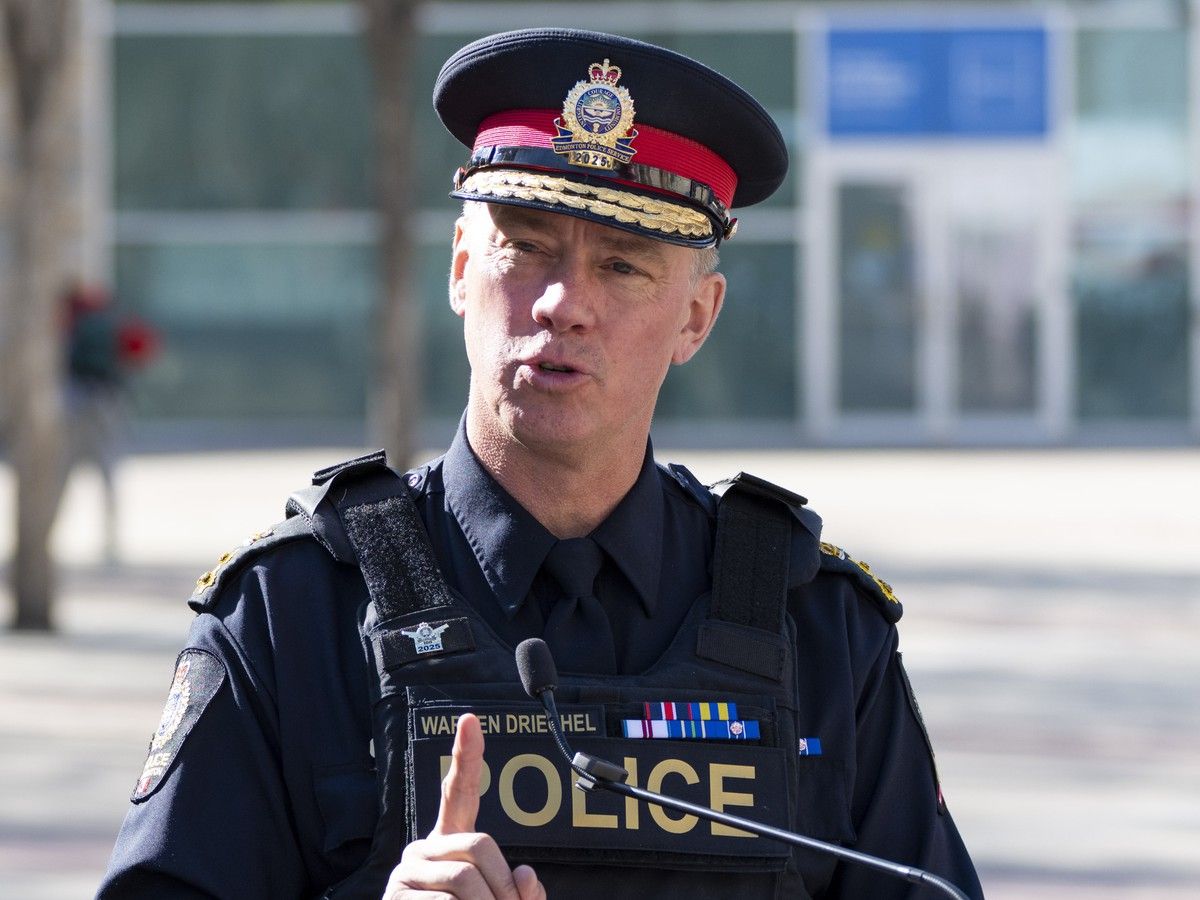
Public comments at Thursday’s Edmonton Police Commission meeting turned into verbal sparring over Chief Warren Driechel’s February trip to Israel, despite signed agreements to avoid talking about global politics in conjunction with the trip organized through the U.S.-based Major Cities Chiefs Association. Commission vice-chairwoman Shazia Amiri told commenters the commission is conducting a policy review to determine whether any policy changes are required. “The commission has made it clear that matters related to conflicts in the Middle East are outside our mandate,” she said, warning that speakers who make personal attacks will have their speaking time ended.
“Our meetings will not be a venue for those looking to divide and create conflict in Edmonton,” she said. The conflict stems from Edmonton Police Service (EPS)’s decision to be the first agency in the world to test a facial recognition program for body-worn cameras from Axon Enterprise Inc., an American company that develops weapons and technology products. Standard body-worn video cameras were adopted in September 2024 as a provincial government mandate.
Facial recognition technology test Known for inventing the Taser, Axon provided the facial recognition technology for the test free of charge. Commenter Beth Capper told Thursday’s meeting the technology poses significant privacy issues for Edmonton residents “who are currently serving as the guinea pigs for the rollout of this tech, which is illegal in many jurisdictions, including much of the European Union.” She added the pilot wasn’t approved by the Alberta Privacy Commissioner.
“What is equally concerning is that the commission so far has posed no real objections to this pilot program, which repeats a current pattern of this commission, rubber-stamping what the EPS does without pushback or transparency over matters of significant public concern,” she said. It is unclear what data will be shared about Canadian citizens with Axon, said Capper, who then went on to criticize the police chief. “I would, of course, like to see Chief Driechel fired, as I believe that his position as chief is untenable and compounds perceptions that the EPS racially targets Edmontonians,” she said.
Carly Perkins got the heave-ho after referring repeatedly to Gaza and Driechel’s trip. “As the chief visited Israel and even had the pleasure of meeting with you-know-who’s private security forces, we’re not going to forget about this trip, Driechel,” Perkins said. “And once more, I’m going to caution you,” Amiri told Perkins.
“But it’s related!” Perkins shot back. “It’s actually not,” Amiri said.
“It’s an Israeli company,“ Perkins replied. “That’s it,” Amiri said, summoning security to escort her out. Police treatment of Indigenous people scrutinized Presenter Ryan O’Toole said she spoke as an Indigenous woman, bringing numbers she found on her own “because statistics specific to police treatment towards Indigenous women or peoples more broadly in Edmonton and Alberta seems to be lacking.”
Nationally, Indigenous women represent 35 per cent of women admitted into adult sentenced custody, though they comprise three per cent of the total population, she said. “Indigenous peoples account for somewhere between 16 and 18 per cent of all police-involved deaths, while comprising around five per cent of the population,” O’Toole said. Since 2000, reporting shows 39 people have died as a result of use of force by the EPS, and Taser use has grown by more than 1,800 per cent since 2010, she said.
“In 2016, Indigenous women in this city were nearly 10 times more likely to be street-checked than white women. Indigenous people generally were six times more likely to be stopped.” The person who stood in front of cameras back then denying racial profiling, she said, was then-staff sgt.
Driechel. “He demonstrates a consistent response when Indigenous overpolicing is raised, over and over. His position is to minimize it or defend it,” O’Toole said.
“In his own briefing, the chief talked about technology for identifying, prioritizing, and acting on credible threats quickly and effectively. That is the language of an occupation apparatus that we as Indigenous peoples are all too familiar with,” O’Toole said. “What happens to Palestinians happens to us as Indigenous peoples.
We are not two separate struggles. We fight for our lives in the face of dispossession of land, surveillance, and elimination,” she said. ‘Having a police state’ Katie Ingram told the commission it is in dereliction of duty and “decimating democracy,” leading her to believe “you are OK with going down the road of having a police state, and I’m not OK with that.”
“That not a single commissioner has resigned based on their conscience is embarrassing.” In a 2019 report, Axon’s AI ethics board concluded facial recognition technology at the time was not yet reliable enough to justify body-worn video cameras due to poor performance when it came to race, ethnicity, and gender. Ann-Li Cooke, the company’s director for responsible AI, told Postmedia last year it evaluated machine-learning models and found the limiting factor was not race but skin tone, as varying conditions like distance and dim lighting can make it harder to match people with darker skin.
Gideon Christian, an associate law professor at the University of Calgary specializing in AI, told Postmedia he was shocked that EPS chose to test the technology, calling it a move from police accountability and transparency to mass surveillance of members of the public. “Can you imagine being a darker-skinned individual, and with high error rate in this tool, you are falsely matched to a suspect?” he said in December.
— With files from Liam Newbigging You can also support our journalism by becoming a digital subscriber. Subscribers gain unlimited access to The Edmonton Journal, Edmonton Sun, National Post and 13 other Canadian news sites. Support us by subscribing today: The Edmonton
Source and reference
Journal | The Edmonton Sun.
Read original source- Published
- Jul 17, 2026
- Updated
- Jul 17, 2026
- Source
- Edmonton Journal
- Category
- Politics
- Read time
- 4 min
Key facts
Why this matters locally
This politics story matters locally because it may affect readers, businesses, commuters, families, or public services in British Columbia.
Local impact
BC Post links this item to British Columbia coverage so readers can follow related city updates, weather, traffic, events, and category news in one place.
Timeline
Source and credit
BC Post may summarize, organize, and add local context for reader clarity. Original reporting remains with the listed publisher.
Related Articles
View all Politics
Powerful pro-life ad featuring boxing legend to air during final World Cup matches
Politics
Powerful pro-life ad featuring boxing legend to air during final World Cup matches
 Politics
Vaughn Palmer: David Eby's slow and expensive step toward involuntary care
Politics
Vaughn Palmer: David Eby's slow and expensive step toward involuntary care
 Politics
Pitt Meadows to host information session for city council candidates
Politics
Pitt Meadows to host information session for city council candidates
 Politics
Hundreds of enthusiatic supporters attend Surrey Mayor Brenda Locke’s fundarising dinner
Politics
Hundreds of enthusiatic supporters attend Surrey Mayor Brenda Locke’s fundarising dinner
 Politics
One hundred affordable housing units for seniors coming to Sherbrooke
Politics
One hundred affordable housing units for seniors coming to Sherbrooke
 Politics
‘No consequences’: East Van woman says she was targeted by hate-motivated assault
Politics
‘No consequences’: East Van woman says she was targeted by hate-motivated assault
More Local Coverage
Latest news Business
AI Market Trends: Q2 2026 Review and Forecast
Business
AI Market Trends: Q2 2026 Review and Forecast
 Local News
Cowichan sports shorts: rugby, hockey, biking
Local News
Cowichan sports shorts: rugby, hockey, biking