

Generative AI has made robust biometric detection systems increasingly critical for fraud prevention. According to new data from Surfshark, deepfake fraud is accelerating sharply, with recorded global losses now reaching $3.7 billion. “Together, 2025 and 2026 account for 89 percent of all recorded global deepfake fraud losses, showing how quickly the threat has escalated,” the research says . Social media is “the single largest origin point for deepfake-related losses,” but impersonation fraud, crypto ATM fraud, fake job candidate schemes and even simple phone calls are now all part of the fraudsters’ arsenal. Synthetic facial verification videos, AI-generated face swaps, voice cloning, forged or altered IDs: generative AI has put all of it on the menu, at bargain prices. Firms are rising to the challenge of providing robust protection across biometric modalities. Modulate , Resemble and Polygraf have all launched deepfake detection products that address specific problems across the fraud spectrum. Modulate: voice-native detection models for audio deepfakes In a blog , Modulate points to its Velma-2 algorithm’s top position on Hugging Face’s Speech Deepfake Leaderboard , “the most comprehensive public benchmark for audio deepfake detection. The firm attributes its success to voice-native detection models, or audio-native ensemble learning models (ELM) models, which ingest raw audio to determine fraud likelihood. The audio-native models can create and analyze spectrograms – “time-frequency maps that reveal unnatural spectral envelopes, missing noise floors, and harmonic smoothness” – but also detect Mel‐Frequency Cepstral Coefficients ( MFCCs ); prosodic features such as stress patterns, jitter, shimmer, breath timing, and pitch contours; and micro‐temporal anomalies including sub‐phoneme irregularities, phase coherence issues, glottal pulse artifacts, and unnatural formant transitions. Modulate says “ensemble architectures run all of the above simultaneously to create a unified prediction, more accurately flagging different attack types, languages, and audio conditions.” The company claims voice-native detection systems “could reduce the negative impacts of false positives by as much as 150,000 false positives per year.” Resemble: neural audio watermarking Resemble.AI, whose Detect algorithm sits in second place on the Hugging Face leaderboard, has published an article on its neural audio watermarking technology, which places a detectable signal inside the audio signal, typically “below normal listening awareness.” “A neural audio watermark is a hidden signal added to an audio file by a machine learning model trained to embed signals imperceptibly yet robustly within audio waveforms,” it says. Unlike metadata, it is not stored only in file information that platforms may remove: “neural audio watermarks live inside the waveform itself, surviving where metadata tags get stripped away during upload or re-encoding.” The piece notes that watermarking works best as one layer beside deepfake detection, speaker identity checks, provenance records, and human review. Polygraf: real-time AI fraud detection for enterprise meetings Polygraf AI has launched Meeting Guard – a product that, according to a release, delivers real-time AI fraud detection and data governance for enterprise virtual meetings across Zoom, Google Meet, and Microsoft Teams. Meeting Guard joins virtual meetings as a visible participant, and serves as “both a secure compliance assistant and an AI notetaker, detecting AI-generated content, verifying voices against deepfake threats, flagging potential PII leaks, and securely generating meeting notes and summaries without transmitting external data.” Polygraf says the tool is built on an encrypted SOC 2 Type II and ISO/IEC 27001 certified infrastructure with a strict No-Training policy, and powered by Polygraf’s AI Behavioral Control Plane. “Every meeting is now a security event ,” says Yagub Rahimov, CEO of Polygraf AI. “AI has fundamentally broken the trust model organizations relied on for remote communication. The ability to verify identity through a face, voice, or conversation is no longer enough. Meeting Guard was built to provide real-time enforcement directly inside enterprise meetings before AI-assisted fraud, deepfake impersonation, or sensitive data exposure turns into financial or operational damage.”
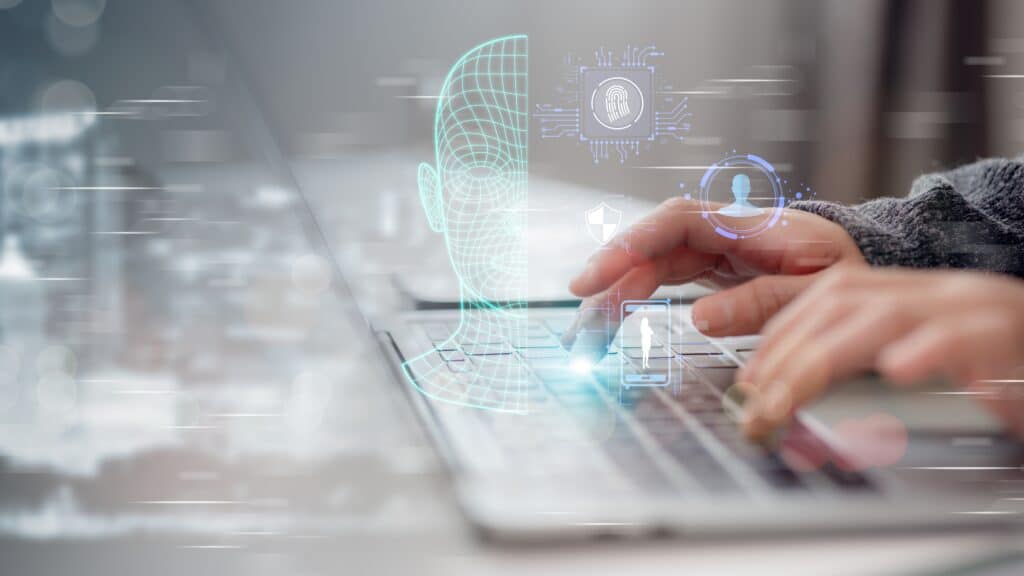
Generative AI has made robust biometric detection systems increasingly critical for fraud prevention. According to new data from Surfshark, deepfake fraud is accelerating sharply, with recorded global losses now reaching $3.7 billion. “Together, 2025 and 2026 account for 89 percent of all recorded global deepfake fraud losses, showing how quickly the threat has escalated,” the research says.
Social media is “the single largest origin point for deepfake-related losses,” but impersonation fraud, crypto ATM fraud, fake job candidate schemes and even simple phone calls are now all part of the fraudsters’ arsenal. Synthetic facial verification videos, AI-generated face swaps, voice cloning, forged or altered IDs: generative AI has put all of it on the menu, at bargain prices. Firms are rising to the challenge of providing robust protection across biometric modalities.
Modulate, Resemble and Polygraf have all launched deepfake detection products that address specific problems across the fraud spectrum. Modulate: voice-native detection models for audio deepfakesIn a blog, Modulate points to its Velma-2 algorithm’s top position on Hugging Face’s Speech Deepfake Leaderboard, “the most comprehensive public benchmark for audio deepfake detection. The firm attributes its success to voice-native detection models, or audio-native ensemble learning models (ELM) models, which ingest raw audio to determine fraud likelihood.
The audio-native models can create and analyze spectrograms – “time-frequency maps that reveal unnatural spectral envelopes, missing noise floors, and harmonic smoothness” – but also detect Mel‐Frequency Cepstral Coefficients (MFCCs); prosodic features such as stress patterns, jitter, shimmer, breath timing, and pitch contours; and micro‐temporal anomalies including sub‐phoneme irregularities, phase coherence issues, glottal pulse artifacts, and unnatural formant transitions. Modulate says “ensemble architectures run all of the above simultaneously to create a unified prediction, more accurately flagging different attack types, languages, and audio conditions.” The company claims voice-native detection systems “could reduce the negative impacts of false positives by as much as 150,000 false positives per year.
”Resemble: neural audio watermarkingResemble. AI, whose Detect algorithm sits in second place on the Hugging Face leaderboard, has published an article on its neural audio watermarking technology, which places a detectable signal inside the audio signal, typically “below normal listening awareness. ”“A
neural audio watermark is a hidden signal added to an audio file by a machine learning model trained to embed signals imperceptibly yet robustly within audio waveforms,” it says. Unlike metadata, it is not stored only in file information that platforms may remove: “neural audio watermarks live inside the waveform itself, surviving where metadata tags get stripped away during upload or re-encoding. ”The
piece notes that watermarking works best as one layer beside deepfake detection, speaker identity checks, provenance records, and human review. Polygraf: real-time AI fraud detection for enterprise meetingsPolygraf AI has launched Meeting Guard – a product that, according to a release, delivers real-time AI fraud detection and data governance for enterprise virtual meetings across Zoom, Google Meet, and Microsoft Teams. Meeting Guard joins virtual meetings as a visible participant, and serves as “both a secure compliance assistant and an AI notetaker, detecting AI-generated content, verifying voices against deepfake threats, flagging potential PII leaks, and securely generating meeting notes and summaries without transmitting external data.
”Polygraf says the tool is built on an encrypted SOC 2 Type II and ISO/IEC 27001 certified infrastructure with a strict No-Training policy, and powered by Polygraf’s AI Behavioral Control Plane. “Every meeting is now a security event,” says Yagub Rahimov, CEO of Polygraf AI. “AI has fundamentally broken the trust model organizations relied on for remote communication.
The ability to verify identity through a face, voice, or conversation is no longer enough. Meeting Guard was built to provide real-time enforcement directly inside enterprise meetings before AI-assisted fraud, deepfake impersonation, or sensitive data exposure turns into financial or operational damage.”
- Published
- Jul 15, 2026
- Updated
- Jul 15, 2026
- Source
- Biometric Update
- Category
- Technology
- Read time
- 3 min
Key facts
Why this matters locally
This technology story matters locally because it may affect readers, businesses, commuters, families, or public services in British Columbia.
Local impact
BC Post links this item to British Columbia coverage so readers can follow related city updates, weather, traffic, events, and category news in one place.
Timeline
Source and credit
BC Post may summarize, organize, and add local context for reader clarity. Original reporting remains with the listed publisher.
Related Articles
View all Technology
Transformer-manufacturing company to shut down its Chilliwack facility
Technology
Transformer-manufacturing company to shut down its Chilliwack facility
 Technology
Spectro Cloud Raises $100 Million Series D to Help Customers Move AI Infrastructure Into Production Across Enterprise, Public Sector, Neocloud and Sovereign Cloud Environments
Technology
Spectro Cloud Raises $100 Million Series D to Help Customers Move AI Infrastructure Into Production Across Enterprise, Public Sector, Neocloud and Sovereign Cloud Environments
 Technology
Quebec announces plan to train more aerospace workers as demand surges
Technology
Quebec announces plan to train more aerospace workers as demand surges
 Technology
Apple’s Lawsuit Could Choke OpenAI’s iPhone Rival Before It Even Ships
Technology
Apple’s Lawsuit Could Choke OpenAI’s iPhone Rival Before It Even Ships
 Technology
ECT Reprograms Adult Neurons into a Youthful State
Technology
ECT Reprograms Adult Neurons into a Youthful State
 Technology
GO train users could face delays, cancellations due to ‘crew constraints’: Metrolinx
Technology
GO train users could face delays, cancellations due to ‘crew constraints’: Metrolinx
More Local Coverage
Latest news Business
AI Market Trends: Q2 2026 Review and Forecast
Business
AI Market Trends: Q2 2026 Review and Forecast
 Politics
Powerful pro-life ad featuring boxing legend to air during final World Cup matches
Politics
Powerful pro-life ad featuring boxing legend to air during final World Cup matches