

The partners involved in the proposed regional network have pushed back the planned implementation with study work ongoing
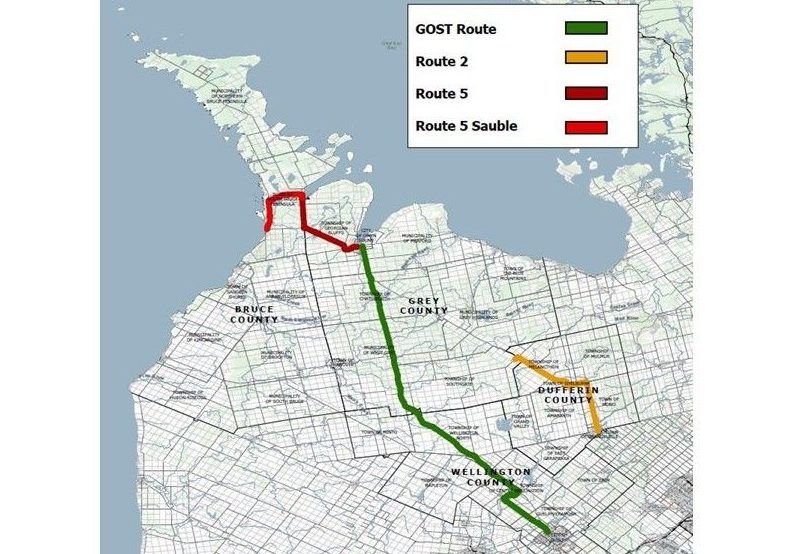
Article content Grey County has backed a plan for temporary inter-community transit service while a regional study into providing transit across four counties continues to be developed. At its committee of the whole meeting on July 9, county council approved a staff recommendation to endorse the contract extension of the Grey Transit Route No. 2 from Dundalk to Orangeville as well as the Guelph Owen Sound Transit (GOST) route between Owen Sound and Guelph until such time as a new regional system is implemented. Recommended Videos Council also agreed to re-introduce the GTR route No. 5 from Owen Sound to Wiarton, as well as a seasonal Sauble Beach service, next year, subject to funding from the province.
That service previously ran from October 2020 to December 2024. The move to implement and extend the temporary services was made while a comprehensive Bruce-Dufferin-Grey-Wellington Regional Transit Study is undertaken. The four counties, along with Saugeen Mobility Regional Transit (SMART) are working towards creating a transit network to serve the region.
Grey County Manager of Community Transportation Stephanie Stewart said during the July 9 meeting that staff from the project partners see value in the services and are aligned in their support to sustain the operations during the study period and using OTIF funding to do so. “Continuing the service ensures that riders are not left without access while long-term solutions are being considered, and helps avoid a loss of ridership,” Stewart said. “It also provides Bruce County with temporary service on a previously popular route including coverage during peak season, until a recommendation on a permanent solution can be developed.”
Stewart said by utilizing 2026 budget allocations from each county and pending OTIF approval from the province, no additional funds are required to maintain the interim phase. Stewart said the interim measures are being taken as they work on what has become a very complex study due to its size and scope. Savanna Myers, director of economic development, tourism and culture, noted that the study area is over 12,000 square kilometres, 53 per cent larger than the Greater Toronto and Hamilton Area.
The partners involved in the project received almost $9.5-million in OTIF funding over five years to fund up to 50 per cent of the cost of the system, which they had hoped to begin implementing later this year. Stewart said the new timeline being proposed by the project team and Dillon Consulting would see the draft study return to council this fall. Staff would then seek direction on budget allocations before presenting the proposed draft 2027 budget for consideration.
The new timeline has final recommendations being brought forward to the partners next year. The county has been collaborating with its partners and Dillon Consulting to identify efficiencies and create a unified regional transit network to serve passengers in the four counties, in particular those in areas that currently have limited transportation options. An interim report that came before council back in March detailing some of the work done so far identified primary destinations for riders and “conceptual corridors” for the regional network.
That report proposed expanding SMART into areas it doesn’t currently service, as well as exploring private sector services like opening up taxis and rideshare regulations, exploring on-demand apps, and working with inter-community carriers on other incentives and opportunities. Stewart said a number of developments have unfolded in recent months, including the Western Ontario Wardens’ Caucus requesting that a Regional Rural Transit Authority be established. “Western Ontario Wardens Caucus is very interested in what this looks like as a model that can be scaled to all of Southwestern Ontario,” Chief Administrative Officer Randy Scherzer said, adding that it is important to do the study work right because there are “lots of folks that are very interested in the results.”
Scherzer said the service has to be scalable and needs to connect with other services beyond the borders of the involved partners, including in Simcoe County.
- Published
- Jul 17, 2026
- Updated
- Jul 17, 2026
- Source
- The Sun Times
- Category
- Technology
- Read time
- 3 min
Key facts
Why this matters locally
This technology story matters locally because it may affect readers, businesses, commuters, families, or public services in British Columbia.
Local impact
BC Post links this item to British Columbia coverage so readers can follow related city updates, weather, traffic, events, and category news in one place.
Timeline
Source and credit
BC Post may summarize, organize, and add local context for reader clarity. Original reporting remains with the listed publisher.
Related Articles
View all Technology
Transformer-manufacturing company to shut down its Chilliwack facility
Technology
Transformer-manufacturing company to shut down its Chilliwack facility
 Technology
Quebec announces plan to train more aerospace workers as demand surges
Technology
Quebec announces plan to train more aerospace workers as demand surges
 Technology
Texting a stranger works better to fight loneliness than talking to an AI chatbot
Technology
Texting a stranger works better to fight loneliness than talking to an AI chatbot
 Technology
End of an Era: OnePlus is Reportedly Shutting Down in the US and Europe This Week
Technology
End of an Era: OnePlus is Reportedly Shutting Down in the US and Europe This Week
 Technology
Apple’s Lawsuit Could Choke OpenAI’s iPhone Rival Before It Even Ships
Technology
Apple’s Lawsuit Could Choke OpenAI’s iPhone Rival Before It Even Ships
More Local Coverage
Latest news Politics
Powerful pro-life ad featuring boxing legend to air during final World Cup matches
Politics
Powerful pro-life ad featuring boxing legend to air during final World Cup matches
 Local News
Cowichan sports shorts: rugby, hockey, biking
Local News
Cowichan sports shorts: rugby, hockey, biking