

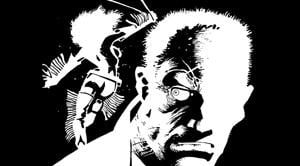
" 'He’s Conan in a trench coat, a one-man wrecking ball,' " Miller wrote to himself as he conceived the next character to change his career.
As a medium, North American comic books took their first successful stab at respectability in the 1980s, and cartoonist Frank Miller was one of the chief reasons why. His work on “Daredevil,” “Batman: Year One” and especially 1986’s “The Dark Knight Returns,” which won vast acclaim, restored the Batman character to popularity and paved the way for the character’s first serious movie and all that came since. It also sent Miller himself to Hollywood as a screenwriter, starting with “Robocop 2,” but as this excerpt from his memoir “Push the Wall: My Life, Writing, Drawing, and the Art of Storytelling” shows, that chapter of his life wasn’t entirely happy, and led him back to comics and his next triumph.
(Excerpt footnoted by Star staff.) I always get into trouble when I’m not writing and drawing. An unmoored feeling sets in and, along with it, a weird and precarious comfort.
In the movie “The Graduate,” the father admonishes his son, Ben, for dithering after college. To his dismay, he finds Ben floating on a raft in the backyard pool. Ben, unbothered, says, “Well, it’s very comfortable just to drift here.”
That’s me when I’m not drawing: just drifting. Comfortable, but squirrelly. It was worse when I was younger, especially in L.A.
I learned the hard way that idle hands are indeed the devil’s playthings. Let’s just say I got really comfortable by the pools and on the bar stools of Los Angeles. Alcohol is, by definition, a poison.
If you got the wrong genes like I do, it will kill you. I wouldn’t stop drinking until I came back to New York, and while the physical effects of getting off it, the cravings, go away pretty quickly, getting your life together ... takes longer. My success was not a suit of armour against the consequences.
My L.A. life in the early to mid-nineties was sunny, but complicated. The disease was setting its own pace. Despite L.A.’s grimier side, it still felt like the most glamorous place on earth, and I loved it.
Part of me did, anyway. As an artist who had toiled in comic books, a field that, after the horrors of 1950s censorship and the madness of the old, now-defunct Comics Code, had a major inferiority complex when it came to holding itself up to the movies, I was told that I had really made it to the big time. Here I was in Hollywood playing with the big boys and girls — the producers and the stars.
I stepped directly from the insular world of comic books into a place of total exposure, one where I didn’t know the rules, but excitement levels were through the roof. After “RoboCop 2” came and went and the excitement from the experience waned, I came to a hard-earned realization. Writing a screenplay can be a lot like carefully casting and assembling what you’re certain is a beautiful fire hydrant, only to watch a long line of dogs come piss on it.
But, golly, is it fun. And then there’s the money. And after the thrill ride, it was back to the drawing board where I wanted to go, where I needed to go.
I decided to finally bring “Sin City” to life. It had been cooking for a very long time. I drew something that was very much like that way back when I was in the seventh grade.
Since then I’d grown up, moved to New York City, and discovered classic Film Noir on late-night television. So I defiantly set out to do a comic just for me, one I didn’t expect to succeed, and one that would never be made into a movie. Until this point, I had always been told that comics were movies on paper, an imitation of movies.
But this just wasn’t holding true for me anymore. In “Sin City,” I wanted to celebrate what comics accomplish on their own: sequential storytelling, panel by panel, with just words and pictures. The two working together and inviting readers to let their minds achieve the rest, using the “gutters” to fill in the blanks.
I knew the time was right. Back at comic book headquarters in New York, all bets were off. The inmates had taken over the asylum.
There was a new sense of freedom because many of those now at the top had grown up loving comics — the art form, not the business — and they were the ones running the show. If you were a comic artist who had experienced some success already, all the better — they gave you an even wider avenue to do what you wanted to do. The phrase “focus group” was becoming a distant memory.
There was no preordained page count, no army of revisionists and opinionators waiting in the wings, no producers or actors to mollify. I was back in charge, just me at the potter’s wheel, centring and shaping and trimming, splattering myself with mud and having a ball. And I was the only voice in the room.
That’s a beautiful thing about cartooning. You don’t need a lot of tools to do it, and it can be done by one person. After all that time spent in the weeds revising and reworking, I wanted to produce something that could cut stone and howl along like a Santa Ana wind.
No more flab, blow through the fluff, just precision and sharpness — black and white would dominate and splashes of colour would punctuate and reinforce. For inspiration, I had decades of film noir, from the classy to the trashy. Then there were the underground comics.
Newer, more experimental works by artists and writers like Chester Brown, Daniel Clowes, Dave Sim, and Jeff Smith. 1 There was a purity about their work that I admired.
Being this was more than enough; it didn’t need to aspire to anything else. You could feel it in the artwork: the playful freedom with, and mastery of, the craft. At the same time, it challenged readers by way of themes and subject matter.
They celebrated the comic art form as a worthwhile medium unto itself, but also made sure no one could banish it to the children’s section. Around this time, I bumped into Dick Giordano 2 at a comic book convention. I told him what I was up to with “Sin City.”
I passed him some early, rough pages of it. When we met up again, Dick said, “Back in the fifties, Noel Sickles 3 taught me to lay in the solid blacks before adding any line work. That’s the way you’re thinking here.
Go ahead and see how many lines you really need — if any.” I started whiting out some of my lines, and the real look of “Sin City” emerged. In just a few words he’d shown me the path.
I punched the “starkness” pedal to the floor. The comic du jour was Marvel’s “Secret Wars,” which pitted superheroes against each other. But I was after something totally different: the sinners and saints from the American fringe.
The dispossessed, the despairing, the forgotten, the lonely, and the violent. I wanted drama. Violence.
Passion. Madness. I wanted a feral atmosphere.
I wanted to take something very old and transform it into something scary and primal. Enter Marv. An imposing brute with an axe to grind and revenge on his mind, a man born out of his time, unafraid to kill, Marv was the anti-hero I needed — an alienated tough guy from the margins who had to sort it out for himself.
Marv’s town, the centre of his struggles, became Basin City, a desert oasis for low-lifes, villains, and rotten cops. Like Los Angeles, Basin City is hot and dry, full of palm trees and sun-baked streets; and surrounded by mountains, desert plains, farmlands, and citrus groves. I decided that three traits would define the characters of Basin City: their jobs, their guilty secrets, and their cars.
It’s just a fact that you can’t draw a place like Los Angeles without drawing beautiful women and cars. This presented drawing challenges I was eager to tackle. I’d been drawing women in every comic I’d made.
Now I’d be drawing plenty more femme fatales, sure. They’d be prostitutes, sure. Haute couture prostitutes who were armed to the teeth and in total command of their territory.
Nothing sad or sleazy. They’d be Valkyries. But the cars — now those looked tough.
Along came friend and soon-to-be collaborator Geof Darrow 4 to the rescue. He encouraged me to think more and more like an animator. As for showing the cars in swift motion, never let them touch the ground!
An airborne hunk of metal with wind beneath it. Hey, it works in the cartoons! When it came to the women, again, the same principle holds (as it does everywhere): cartoon!
Yes, of course, study as much as possible from real life models or photography, but learn to construct — or build — a figure. Then learn what to emphasize or exaggerate. Hint: it’s often not the breasts.
The feeling of working alone and creating something out of whole cloth coupled with the pure rewards of getting back to basics to solve drawing problems left me feeling born again as a cartoonist. My hero, Marv, only enhanced the purification. When I started “Sin City,” Marv, in terms of character traits, was a lot like Mickey Spillane’s rogue detective, Mike Hammer, an unharnessed, two-fisted tough guy full of rage.
But underneath it all, Hammer remains human — he’s a crime fighter with an agenda. At first Marv was on a human scale like Hammer, but it wasn’t working the way I wanted. He needed to be more than that — an almost indestructible force.
So I turned Marv into what I call a “punching bag character,” a character you can put in the absolute worst situations and they’ll find a way out. In the first volume of “Sin City,” “The Hard Goodbye,” Marv gets locked in a basement with his tough-as-nails parole officer who lost her hand to a killer, who chopped it off and ate it. They’re stuck in a small room behind a steel door that is bolted shut from the outside and reinforced with a long security bar.
There is no way out, no exit from their nightmare. This is the end. Marv throws himself against the door to no avail.
He gathers his strength and goes at it until it crashes down. This is a pivotal scene because Marv does what no one else can do — he frees them from what, just moments ago, seemed like an impossible situation. And he does this with a complete lack of wit, cleverness, or acrobatics.
It goes back to the very first note I made to myself about Marv: “He’s Conan in a trench coat, a one-man wrecking ball.” He fulfils a fundamental human wish: He always finds a way out. Until he doesn’t.
Marv was an original: a new type of anti-hero who I wanted to put through his paces as long as possible. After seven volumes, I think I’ve proven that I’m always ready to return to the world of “Sin City.” The story sprawled and I let it take me where it wanted to go.
Structure isn’t the be-all and end-all, and sometimes you have to let it go, be without it or, more accurately, let yourself be unaware of structure as your subconscious builds it for a while. If the story is pulling you along and you’re in the flow, stay there and let it ride. It will surprise you at times or pop out that crown jewel of fictioneering: the epiphany.
That discovery that makes you slap your forehead and cry out, “Of course!” As I like to call it, the inevitable surprise. Oddly enough, this raw tale of vengeance full of blood and guts cleansed my creative palate.
It was a turning point, and the alternate universes of Hollywood’s crowded read-through tables and buzzing sets and the silo of my studio showed me that I could thrive in both places, and that, in fact, knowledge of this new one might reveal much to me about my old sweet home. Excerpted from “Push the Wall” by Frank Miller. Copyright © 2026 by Frank Miller.
Shared with permission of Saga Press/Simon & Schuster Canada.
- Published
- Jul 12, 2026
- Updated
- Jul 12, 2026
- Source
- The Star
- Category
- Entertainment
- Read time
- 10 min
Key facts
Why this matters locally
This entertainment story matters locally because it may affect readers, businesses, commuters, families, or public services in British Columbia.
Local impact
BC Post links this item to British Columbia coverage so readers can follow related city updates, weather, traffic, events, and category news in one place.
Timeline
Source and credit
BC Post may summarize, organize, and add local context for reader clarity. Original reporting remains with the listed publisher.
Related Articles
View all Entertainment
Tom Cruise unrecognizable with a gut and grey hair in ‘Digger’ trailer
Entertainment
Tom Cruise unrecognizable with a gut and grey hair in ‘Digger’ trailer
 Entertainment
Kultrun World Music Festival visits Waterloo Park
Entertainment
Kultrun World Music Festival visits Waterloo Park
 Entertainment
Langley’s tbird hosts country music concert
Entertainment
Langley’s tbird hosts country music concert
 Entertainment
17 Xbox Game Pass title updates you might've missed this week
Entertainment
17 Xbox Game Pass title updates you might've missed this week
 Entertainment
Information sessions for national artistic funding set to be held at EA Rawlinson
Entertainment
Information sessions for national artistic funding set to be held at EA Rawlinson
 Entertainment
Hundreds pack Maple Ridge wharf for Tragically Hip tribute
Entertainment
Hundreds pack Maple Ridge wharf for Tragically Hip tribute
More Local Coverage
Latest news Business
AI Market Trends: Q2 2026 Review and Forecast
Business
AI Market Trends: Q2 2026 Review and Forecast
 Politics
Powerful pro-life ad featuring boxing legend to air during final World Cup matches
Politics
Powerful pro-life ad featuring boxing legend to air during final World Cup matches
 Local News
Cowichan sports shorts: rugby, hockey, biking
Local News
Cowichan sports shorts: rugby, hockey, biking