

Midsona Q2 2026 slides: margins expand as brand shift accelerates
U.S. futures slide with AI worries in focus; Netflix disappoints Introduction & Market Context Midsona AB presented its second quarter and first half 2026 results on July 17, 2026, showcasing meaningful profitability improvements even as the Swedish natural and healthy food company continues navigating a strategic transition from lower-margin contract manufacturing to higher-value consumer brands. The company, which operates across seven European countries with approximately 50 owned brands and 700 employees, reported EBIT growth of SEK 16 million year-over-year despite a 1.2% decline in organic sales. The presentation comes as Midsona’s shares trade at $15.6, near the top of their 52-week range of $10.5 to $15.6, reflecting a 48% gain over the past six months.
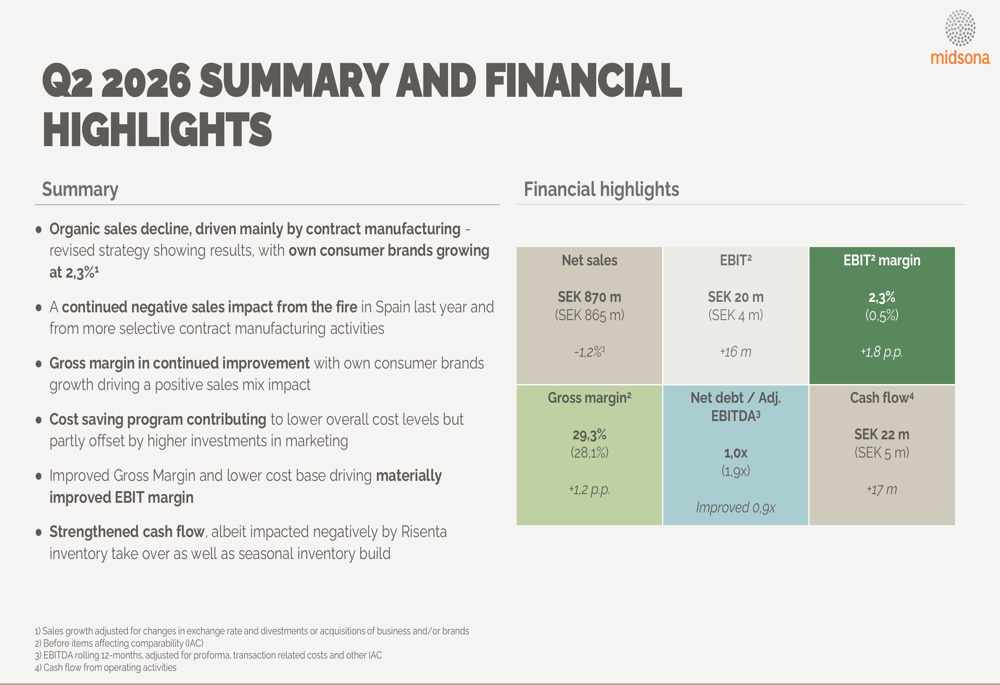
The company’s strategic repositioning appears to be gaining traction with investors, even as the turnaround remains incomplete. Quarterly Performance Highlights Midsona’s second quarter demonstrated the company’s ability to expand margins while managing top-line pressures. Net sales reached SEK 870 million, up 0.5% on a reported basis but down 1.2% organically as the company deliberately reduced lower-margin contract manufacturing activities and continued feeling effects from a fire at its Spanish facility last year.
The following table presents the company’s key financial metrics for the quarter and first half: The most significant development was the quadrupling of EBIT to SEK 20 million from SEK 4 million in the prior year, driving the EBIT margin to 2.3% from 0.5%. This 1.8 percentage point improvement reflects the company’s strategic focus on profitability over volume growth. Critically, own consumer brands—the core of Midsona’s long-term strategy—grew 2.3% organically in the quarter, marking the fourth consecutive quarter of growth in this segment.
This positive momentum in the company’s highest-margin products helped offset an 11.1% decline in contract manufacturing, which management has been deliberately pruning to optimize profitability. First Half Performance and Financial Strength For the first six months of 2026, Midsona demonstrated similar trends with even stronger cash generation.
The comprehensive financial summary below illustrates the company’s progress: Net sales for the half reached SEK 1,763 million, down 1.2% organically but showing improved profitability across key metrics. EBIT climbed to SEK 65 million from SEK 41 million, expanding the margin to 3.7% from 2.3%. Gross margin improved 1.1 percentage points to 29.5%, driven by favorable product mix as higher-margin own brands gained share.
The company’s balance sheet showed marked improvement, with net debt declining to SEK 317 million and the leverage ratio falling to 1.0x adjusted EBITDA from 1.9x a year earlier. This deleveraging provides Midsona with increased financial flexibility to invest in brand building and complete the integration of its recent Risenta acquisition. Operating cash flow strengthened to SEK 56 million from SEK 40 million, supported by an insurance settlement related to the Spanish fire, though partially offset by inventory builds associated with the Risenta integration and seasonal factors.
Detailed Financial Analysis A closer examination of net sales reveals the underlying dynamics of Midsona’s business transformation. The waterfall chart below breaks down the components of sales change: While reported sales edged higher, the organic decline of SEK 10 million was more than offset by favorable foreign exchange effects of SEK 11 million and structural changes adding SEK 5 million. More importantly, the composition of sales shifted meaningfully toward higher-value products, with own consumer brands (66% of sales) growing 2.3% while contract manufacturing (20% of sales) declined 11.1%.
The EBIT bridge demonstrates how Midsona converted sales mix improvements into bottom-line gains: Gross margin contributed SEK 14 million to EBIT growth, driven by pricing actions, improved product mix, and enhanced production efficiency. This more than offset a modest SEK 1 million volume headwind. Lower overhead costs from the company’s 2025 cost-saving program added SEK 1 million, though this was partially offset by increased marketing investments behind key brands.
Foreign exchange provided an additional SEK 2 million tailwind. Cash flow generation improved substantially, as illustrated in the following breakdown: Starting from earnings before tax of SEK 12 million, the company generated SEK 22 million in operating cash flow after adding back SEK 28 million in depreciation and amortization. Working capital consumed SEK 24 million, driven by a SEK 46 million inventory build related to Risenta integration and seasonal factors, partially offset by SEK 63 million in receivables collection.
Divisional Performance and Geographic Mix Midsona’s three operating divisions showed varying performance, reflecting different market conditions and strategic priorities: Division Nordics, representing 63% of sales, delivered 0.5% organic growth with EBIT surging 52% to SEK 38 million. The division benefited from healthy growth in own consumer brands recovering after a weaker first quarter, improved gross margin from favorable mix, and meaningful EBIT margin expansion from both gross margin gains and cost savings. Division North (26% of sales) faced headwinds with organic sales declining 3.7%, driven by weakness in own consumer brands.
However, EBIT held steady at SEK 5 million as the division continued improving production and logistics efficiency and saw stabilizing results in its B2B brand transition. Division South (11% of sales) experienced a 7% organic sales decline, largely due to reduced contract manufacturing following the Spanish fire. However, own consumer brands grew 6.6% with strong performance in French grocery trade, and gross margin improved materially through efficiency gains and favorable sales mix, driving EBIT to SEK 2 million from breakeven.
Portfolio Performance by Category Across Midsona’s product portfolio, performance varied by category: Organic products, representing 58% of sales, declined 1% organically as growth in own organic brands was insufficient to offset weaker contract manufacturing partly impacted by the Spanish fire. However, marketing and innovation initiatives showed positive results in most markets, with Division North being the exception. Health Foods (28% of sales) delivered 3% organic growth driven by larger brands, representing a recovery after a weaker first quarter.
The company attributed this to investments behind major brands such as Friggs, while consciously allowing contract manufacturing to decline to optimize profitability. Consumer Health products (14% of sales) faced the steepest decline at 9% organically, impacted by weak sales of seasonal products, temporary channel shifts, and conscious optimization for profitability affecting certain brands. Strategic Initiatives:
Friggs Protein Launch A highlight of the quarter was the launch of Friggs protein crackers, tapping into the high-protein trend that represents one of the fastest-growing segments in healthy snacking: The new range features 23% protein content made with lentils and peas, offering a naturally protein-rich snack in familiar flavors including cheese, popcorn, and sour cream & onion. The company invested in strong launch visibility through media, digital channels, PR, influencers, and in-store promotions, with initial results showing positive reception. The bar chart in the presentation indicates Friggs sales grew meaningfully in Q2 2026 compared to the prior year, demonstrating the brand’s momentum.
This innovation exemplifies Midsona’s strategy of investing behind selective power brands with considerable potential for profitable growth, one of the company’s three core strategic levers. Gross Margin Expansion Drivers The company’s gross margin improvement varied by division but showed positive momentum across all three regions: Division Nordics expanded gross margin by 0.7 percentage points through improved product mix with higher consumer brand sales, continued strong price management offsetting higher transport and packaging costs from Middle East disruptions, and healthy production and logistics efficiency. Division North improved by 0.3 percentage points despite negative sales segment mix, driven by continuously improved production and logistics efficiency and more stable B2B sales with continued margin improvement.
Division South achieved the strongest expansion at 4.3 percentage points, primarily from favorable sales mix with consumer brand growth and contract manufacturing decline following the fire, though partially offset by somewhat weaker production efficiency due to capacity constraints. Progress Toward Financial Targets Midsona tracks three key financial metrics against long-term targets, showing clear directional progress even as significant gaps remain: Organic growth in own consumer brands reached 2.2% on a last-twelve-months basis, up from negative 3.3% in late 2022, though still well below the company’s target of greater than 5%.
The consistent upward trend since early 2023 suggests the strategy is gaining traction. EBIT margin (excluding items affecting comparability) improved to 4.4% on a rolling twelve-month basis from 0.8% in late 2022, moving toward the greater than 8% target. The steady progression reflects both gross margin expansion and operating leverage from cost reduction initiatives.
Net debt to adjusted EBITDA fell to 1.0x, comfortably below the target of less than 2.5x and down from 4.4x in late 2022. This deleveraging provides financial flexibility for brand investments and the Risenta integration. Balance Sheet Strength and Liquidity Midsona’s financial position strengthened considerably over the past two years: Available cash (including unutilized credit facilities) reached SEK 745 million, equal to 21% of trailing twelve-month sales, up from 15% two years earlier.
This provides substantial liquidity cushion for operations and strategic initiatives. Net debt including IFRS 16 lease obligations declined to SEK 317 million from SEK 543 million two years ago, while the leverage ratio improved from 2.1x to 1.0x. The combination of debt reduction and EBITDA growth drove this improvement, creating capacity for growth investments.
Forward-Looking Statements and Challenges Management outlined three short-term priorities: ensuring focused implementation of the refined strategy to accelerate growth toward financial targets, leveraging growth momentum in own consumer brands through focused product and marketing initiatives, and defining the right long-term business model and production structure for profitable business recovery in Spain. The company expects own consumer brands to continue growing, supported by innovation and marketing investments. The Risenta acquisition should contribute approximately SEK 130 million in annual run-rate sales, assuming minimal cross-selling in 2026, with some one-off integration costs expected in the third and fourth quarters as equipment and supply chain operations are moved.
Management indicated the impact from the Spanish fire should fade during the third quarter, improving contract manufacturing comparisons. With most contract manufacturing pruning now complete, future capacity can be shifted toward higher-margin consumer brands. However, significant challenges remain.
Organic sales are still negative overall, showing the turnaround is incomplete. Consumer health products declined 9% organically in the quarter, and Division North faces ongoing pressures. The company remains far from its long-term targets, with own brand growth at 2.2% versus a 5% target and EBIT margin at 4.4% versus an 8% target.
Despite these headwinds, the presentation demonstrates clear progress in Midsona’s strategic transformation. The company is successfully shifting its business mix toward higher-value products, expanding margins through operational efficiency and pricing discipline, and strengthening its balance sheet to support future growth investments. Whether this momentum can accelerate to meet long-term targets remains the key question for investors as the turnaround continues.
Full presentation:
- Published
- Jul 17, 2026
- Updated
- Jul 17, 2026
- Source
- Investing Canada
- Category
- Technology
- Read time
- 8 min
Key facts
Why this matters locally
This technology story matters locally because it may affect readers, businesses, commuters, families, or public services in British Columbia.
Local impact
BC Post links this item to British Columbia coverage so readers can follow related city updates, weather, traffic, events, and category news in one place.
Timeline
Source and credit
BC Post may summarize, organize, and add local context for reader clarity. Original reporting remains with the listed publisher.
Related Articles
View all Technology
Transformer-manufacturing company to shut down its Chilliwack facility
Technology
Transformer-manufacturing company to shut down its Chilliwack facility
 Technology
Spectro Cloud Raises $100 Million Series D to Help Customers Move AI Infrastructure Into Production Across Enterprise, Public Sector, Neocloud and Sovereign Cloud Environments
Technology
Spectro Cloud Raises $100 Million Series D to Help Customers Move AI Infrastructure Into Production Across Enterprise, Public Sector, Neocloud and Sovereign Cloud Environments
 Technology
Quebec announces plan to train more aerospace workers as demand surges
Technology
Quebec announces plan to train more aerospace workers as demand surges
 Technology
Apple’s Lawsuit Could Choke OpenAI’s iPhone Rival Before It Even Ships
Technology
Apple’s Lawsuit Could Choke OpenAI’s iPhone Rival Before It Even Ships
 Technology
ECT Reprograms Adult Neurons into a Youthful State
Technology
ECT Reprograms Adult Neurons into a Youthful State
 Technology
GO train users could face delays, cancellations due to ‘crew constraints’: Metrolinx
Technology
GO train users could face delays, cancellations due to ‘crew constraints’: Metrolinx
More Local Coverage
Latest news Business
AI Market Trends: Q2 2026 Review and Forecast
Business
AI Market Trends: Q2 2026 Review and Forecast
 Politics
Powerful pro-life ad featuring boxing legend to air during final World Cup matches
Politics
Powerful pro-life ad featuring boxing legend to air during final World Cup matches