

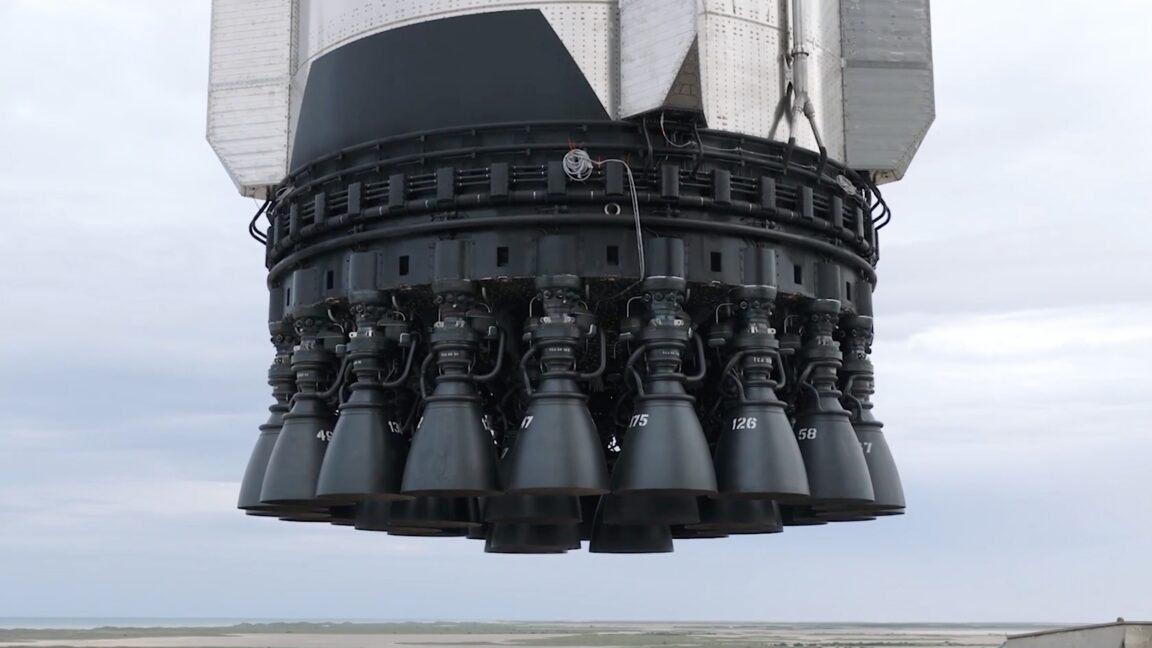
This flight will put Starship under higher pressure and test out new Starlink satellites in orbit.
The next test flight of SpaceX’s Starship spacecraft and Super Heavy booster could take off as soon as Thursday, and much of the hour-long mission will look a lot like the last Starship flight in May. But there are a few key differences for this launch, set to occur during a launch window that opens at 5:45 pm CDT (22:45 UTC) on Thursday. The most notable change is the inclusion of real, functioning Starlink satellites inside Starship’s cargo bay.
SpaceX previously tested the ship’s payload deployment mechanism using simulators mimicking the mass and dimensions of the company’s next-generation Starlink Version 3 broadband satellites. This time—Starship’s 13th full-scale test flight and the second to use SpaceX’s newest version of Starship—technicians have installed 20 Starlink V3 satellites into the ship’s deployer, a system of pulleys and cables designed to eject a stack of satellites one at a time through an opening on the side of the spacecraft. The satellites will not be part of SpaceX’s operational network, but engineers will attempt to briefly establish laser communication links between the Starlink V3s and other spacecraft flying in low-Earth orbit.
If successful, these links will validate Starlink V3’s interoperability with SpaceX’s previous generation of Starlink satellites. As with all of SpaceX’s previous Starship test flights, the more than 400-foot-tall rocket will fly on a long suborbital trajectory arcing halfway around the world from the launch site at Starbase, Texas, to a predetermined location in the Indian Ocean. The flight of Starship and the 20 Starlink satellites will last a little more than an hour before they fall back into the atmosphere.
The ship will target a controlled splashdown northwest of Australia, while the Starlink satellites will burn up during reentry. A new ingredient The flight plan for this week’s mission has just enough time in space for the Starlink satellites to extend their solar arrays and antennas. The satellites will also attempt to connect with ground stations in South Africa as they soar nearly more than 100 miles overhead.
- Published
- Jul 13, 2026
- Updated
- Jul 13, 2026
- Source
- Ars Technica
- Category
- Technology
- Read time
- 2 min
Key facts
Why this matters locally
This technology story matters locally because it may affect readers, businesses, commuters, families, or public services in British Columbia.
Local impact
BC Post links this item to British Columbia coverage so readers can follow related city updates, weather, traffic, events, and category news in one place.
Timeline
Source and credit
BC Post may summarize, organize, and add local context for reader clarity. Original reporting remains with the listed publisher.
Related Articles
View all Technology
Transformer-manufacturing company to shut down its Chilliwack facility
Technology
Transformer-manufacturing company to shut down its Chilliwack facility
 Technology
Spectro Cloud Raises $100 Million Series D to Help Customers Move AI Infrastructure Into Production Across Enterprise, Public Sector, Neocloud and Sovereign Cloud Environments
Technology
Spectro Cloud Raises $100 Million Series D to Help Customers Move AI Infrastructure Into Production Across Enterprise, Public Sector, Neocloud and Sovereign Cloud Environments
 Technology
Quebec announces plan to train more aerospace workers as demand surges
Technology
Quebec announces plan to train more aerospace workers as demand surges
 Technology
Apple’s Lawsuit Could Choke OpenAI’s iPhone Rival Before It Even Ships
Technology
Apple’s Lawsuit Could Choke OpenAI’s iPhone Rival Before It Even Ships
 Technology
ECT Reprograms Adult Neurons into a Youthful State
Technology
ECT Reprograms Adult Neurons into a Youthful State
 Technology
GO train users could face delays, cancellations due to ‘crew constraints’: Metrolinx
Technology
GO train users could face delays, cancellations due to ‘crew constraints’: Metrolinx
More Local Coverage
Latest news Business
AI Market Trends: Q2 2026 Review and Forecast
Business
AI Market Trends: Q2 2026 Review and Forecast
 Politics
Powerful pro-life ad featuring boxing legend to air during final World Cup matches
Politics
Powerful pro-life ad featuring boxing legend to air during final World Cup matches