

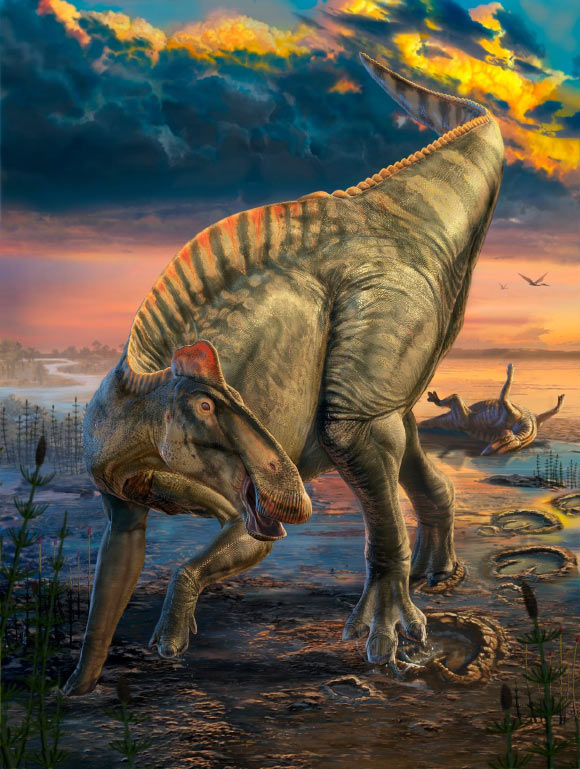
Thousands of fossilized bones from a Cretaceous-period bonebed in Wyoming, the United States, offer rare physical evidence that Tyrannosaurus rex fed on the carcasses of a duck-billed dinosaur species called Edmontosaurus annectens.
Thousands of fossilized bones from a Cretaceous-period bonebed in Wyoming, the United States, offer rare physical evidence that Tyrannosaurus rex fed on the carcasses of a duck-billed dinosaur species called Edmontosaurus annectens. “Identifying the origin of perforating lesions on fossil bone is often difficult, and many are considered tooth traces, in spite of more likely and more parsimonious etiologies,” said Loma Linda University paleontologist Bethania Siviero and colleagues said. “Much of this confusion stems from tooth trace criteria that are ambiguous when the context for the lesions is not considered.”
“Mistaken identification of tooth traces has led to misleading interpretations of animal behavior.” “Our study of tooth traces on fossil bones critically reviews previous criteria.” In their research, Dr. Siviero and co-
Source and reference
authors examined 3,013 bones excavated between 1997 and 2017 from a paleontological site near Hanson Ranch Station in northeastern Wyoming, part of the Lance Formation. The bones belonged overwhelmingly to a single species of large plant-eating hadrosaur, Edmontosaurus annectens. Only a small fraction of the bones — thirteen out of 3,013 — showed marks resembling tooth traces. After closer analysis, including CT scans, the paleontologists determined that one of those was not a bite mark at all but a natural anatomical feature. Of the twelve bones confirmed to bear genuine tooth traces — including ribs, vertebrae, a radius and an ulna — four preserved distinctive patterns attributable to two known ichnospecies, Knethichnus parallelum and Linichnus serratus. By comparing the spacing of these marks to the tooth structure of predators known to have lived in the same ecosystem, the...
Read original source- Published
- Jul 15, 2026
- Updated
- Jul 15, 2026
- Source
- Sci.news: Breaking Science News
- Category
- Technology
- Read time
- 2 min
Key facts
Why this matters locally
This technology story matters locally because it may affect readers, businesses, commuters, families, or public services in British Columbia.
Local impact
BC Post links this item to British Columbia coverage so readers can follow related city updates, weather, traffic, events, and category news in one place.
Timeline
Source and credit
BC Post may summarize, organize, and add local context for reader clarity. Original reporting remains with the listed publisher.
Related Articles
View all Technology
Transformer-manufacturing company to shut down its Chilliwack facility
Technology
Transformer-manufacturing company to shut down its Chilliwack facility
 Technology
Quebec announces plan to train more aerospace workers as demand surges
Technology
Quebec announces plan to train more aerospace workers as demand surges
 Technology
Texting a stranger works better to fight loneliness than talking to an AI chatbot
Technology
Texting a stranger works better to fight loneliness than talking to an AI chatbot
 Technology
End of an Era: OnePlus is Reportedly Shutting Down in the US and Europe This Week
Technology
End of an Era: OnePlus is Reportedly Shutting Down in the US and Europe This Week
 Technology
Apple’s Lawsuit Could Choke OpenAI’s iPhone Rival Before It Even Ships
Technology
Apple’s Lawsuit Could Choke OpenAI’s iPhone Rival Before It Even Ships
More Local Coverage
Latest news Politics
Powerful pro-life ad featuring boxing legend to air during final World Cup matches
Politics
Powerful pro-life ad featuring boxing legend to air during final World Cup matches
 Local News
Cowichan sports shorts: rugby, hockey, biking
Local News
Cowichan sports shorts: rugby, hockey, biking