

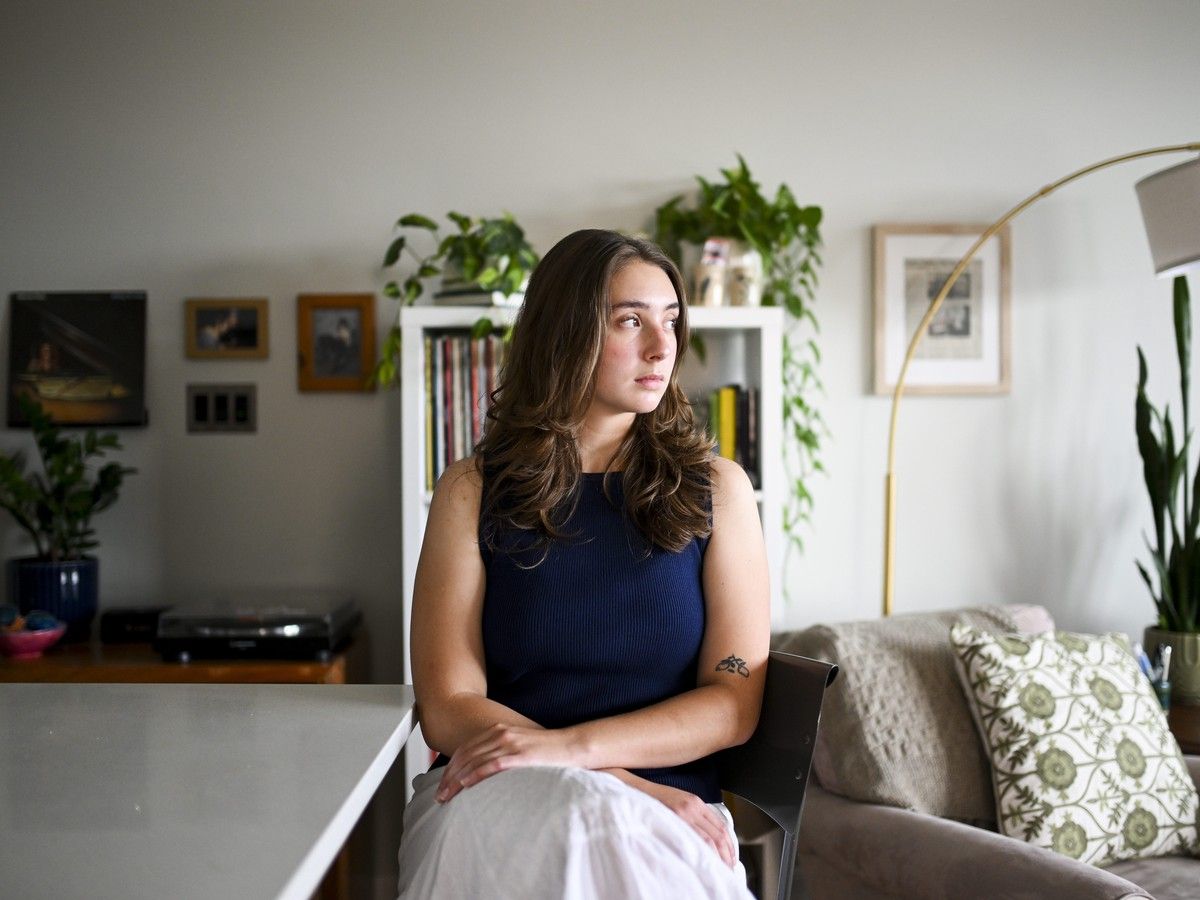
Local families are pledging to keep their kids offline, but as someone who smuggled Snapchat past her parents, I have doubts.
It’s hard to lock the bathroom door because I’m shaking. I slump over on the ground, iPad tucked under my sweatshirt. Chest pounding, I type in the password.
Usually, I’d do this on my phone, but it was taken away for failing a math exam or something. The app downloads and the screen turns an obnoxious glowing yellow. This is Snapchat.
In my pubescent world, this is a big deal. I log in with my top-secret credentials and get to work. I don’t have much time before one of my parents asks what I’m up to.
At 15, there is quite literally nothing more important than taking a picture of the ceiling (maybe with a bit of the side of my face in there), typing the word “streaks” onto it, and sending it to a list of classmates so as not to break our daily chain of sending ceiling pictures to each other. Though the federal government has recently decided, like my parents, that kids 16 and under won’t be allowed to access social media apps, today’s youth will almost certainly take it into their own hands, too.
What is Bill C-34, the Safe Social Media Act? In June, Culture Minister Marc Miller formally introduced the long-anticipated Bill C-34, the Safe Social Media Act. The Government of Canada’s website says that under the act, social media services and AI chatbot services are subject to the core “Duty to Protect Children”, which requires regulated services to implement design features to make their services safer for children.
It also means kids under 16 will be subject to age verification or estimation. This follows similar international bans that vary from ages 14 to 16 in countries like the U.K., Spain, Denmark, Indonesia, and Australia. Australia was the world’s first to do it, only about six months ago.
But according to Reuters, they’re already having difficulties. Children were still on the platforms, and social media giants like Meta, TikTok and Snapchat weren’t doing much to stop them. The only way to get kids not to want something is to make sure everyone around them doesn’t already have it.
That sounds like an impossible feat, right? The folks at Unplugged Canada don’t think so. Delaying social media Informed by their bible, Jonathan Haidt’s influential 2024 book The Anxious Generation, Unplugged Canada has parents pledge to delay giving their kids phones until 14 and social media until 16.
Tara Borowiecki, the head of its Ottawa chapter, told me that the organization has only been around for a year and a half, but they already have groups in almost every province and territory. Borowiecki says Unplugged works because it gives them a community. “It takes isolation and aloneness out of it.
They are no longer the only kid without a smartphone, or the only kid without social media, and the way the pledge works is it goes by school, by grade,” Borowiecki says. When parents in Ottawa sign the pledge, they get contact information from others in their area who’ve done the same. In Ontario, there are 6,752 pledges signed from 606 schools, with Mutchmor Public School in the Glebe having one of the highest counts in Canada and the second-highest count in Ontario at 215 pledges.
So, I talked to some Ottawa parents who have done it, and their kids, to see how they feel about it. The reaction was, let’s say, mixed. Caleb
He chose to be identified as such in this story because of the quarterback of the Chicago Bears, Caleb Williams. Caleb is six years old. His mother, Jessica Ames, has already signed Unplugged’s pledge.
When Caleb sees others using their phones, he says it gives him a bad feeling. “Screens are bad for you. It hurts your brain,” he told me.
Despite this, when I asked Caleb if he’s going to get a phone when he’s older, he said yes, and that it will be an Edmonton Oilers phone so he can play video games, text, and “make parties.” But Ames is worried about what her six-year-old will encounter online, beyond making parties. “It’s a scary place.
I have no idea how I will protect my children from it. I noticed that because I was on my phone so much, he was reaching for it too, constantly,” she says. She recently deleted social media so her kids won’t see her scrolling.
Alex This 13-year-old, who chose to be identified as Alex, wants a phone so he can talk to his friends more, but he says he understands his parents’ decision. Farr Redmond says the group helps alleviate some of this overwhelm by giving her hope through a community around her that feels similar. She also says it’s a never-ending conversation with Alex and her 11-year-old daughter about screens — and they don’t even talk about social media yet.
“It’s exhausting. It really feels like you’re fighting against this huge thing that we don’t have a lot of control over,” she says, adding that she’s aiming to delay both smartphones and social media until 18. Right now, Alex goes to a Waldorf-style school with few screens.
But when he gets to high school, Farr Redmond isn’t sure what will happen. “They’re sheltered from it. I’m hoping that this will put in some good habits for those really difficult years.
But these things aren’t easy. And we’re two parents.” Vanessa and Felicia Emily Chan says it’s difficult to enforce her rules around cell phones and social media because she shares custody of her two kids.
“I only have control half of the time,” Chan says. These girls, who chose Vanessa and Felicia as their aliases, aren’t keen on their mom’s decision to sign the pledge. In fact, one of them had just gotten caught using TikTok days before I chatted with them.
“(Vanessa’s) dad had given her his old phone that she could use at home. But she slowly started bringing it out because the school called me one day and said, ‘Oh, we have your kid’s phone,’ and I was like, ‘She doesn’t have a phone,’” Chan says. But it was, indeed, Vanessa’s phone.
She says it’s broken now, and she and her sister now have to make plans with friends through their mom. Aside from the pledge, mom doesn’t want them on social media until they’re 18. “I don’t like it.
It’s annoying,” says Felicia. She complains of a lack of privacy because her mom can read her texts with her friends. Vanessa feels left out by not having TikTok anymore.
“Everyone I know has a phone,” adds Vanessa, who is now 14. Twelve-year-old Felicia says that all of her friends have both social media and phones. “If kids don’t have phones and they want one, then they’ll probably go get social media,” Vanessa says.
“It’s better that (parents) know if they were on it than if (they) don’t, cause then it could be a lot more dangerous for them.” Olivia I’m years past being a teenager. And I’m proud to say my days of sending Snapchat streaks are long over.
Looking back, I’m glad my parents tried to prevent phone addiction before my brain was fully developed. And they tried pretty hard, even if they failed. But it remains the unfortunate truth that strict parents make sneaky kids.
Their restrictions around my social media use only made it cooler. As I think about the children of Unplugged Canada, or the youth who will be directly impacted by Bill C-34, I look back at my 16th birthday: neatly folded up in an envelope in classic dad fashion was a piece of printer paper that said I was finally allowed to have Snapchat. I feigned being happy or relieved.
It was embarrassing at that point — so far through high school, so almost an adult — that it was so late to finally be allowed what everyone else had. Besides, I had already taken it into my own hands.
- Published
- Jul 17, 2026
- Updated
- Jul 17, 2026
- Source
- Ottawa Citizen
- Category
- Politics
- Read time
- 6 min
Key facts
Why this matters locally
This politics story matters locally because it may affect readers, businesses, commuters, families, or public services in British Columbia.
Local impact
BC Post links this item to British Columbia coverage so readers can follow related city updates, weather, traffic, events, and category news in one place.
Timeline
Source and credit
BC Post may summarize, organize, and add local context for reader clarity. Original reporting remains with the listed publisher.
Related Articles
View all Politics
Powerful pro-life ad featuring boxing legend to air during final World Cup matches
Politics
Powerful pro-life ad featuring boxing legend to air during final World Cup matches
 Politics
Vaughn Palmer: David Eby's slow and expensive step toward involuntary care
Politics
Vaughn Palmer: David Eby's slow and expensive step toward involuntary care
 Politics
Pitt Meadows to host information session for city council candidates
Politics
Pitt Meadows to host information session for city council candidates
 Politics
Hundreds of enthusiatic supporters attend Surrey Mayor Brenda Locke’s fundarising dinner
Politics
Hundreds of enthusiatic supporters attend Surrey Mayor Brenda Locke’s fundarising dinner
 Politics
One hundred affordable housing units for seniors coming to Sherbrooke
Politics
One hundred affordable housing units for seniors coming to Sherbrooke
 Politics
‘No consequences’: East Van woman says she was targeted by hate-motivated assault
Politics
‘No consequences’: East Van woman says she was targeted by hate-motivated assault
More Local Coverage
Latest news Business
AI Market Trends: Q2 2026 Review and Forecast
Business
AI Market Trends: Q2 2026 Review and Forecast
 Local News
Cowichan sports shorts: rugby, hockey, biking
Local News
Cowichan sports shorts: rugby, hockey, biking