

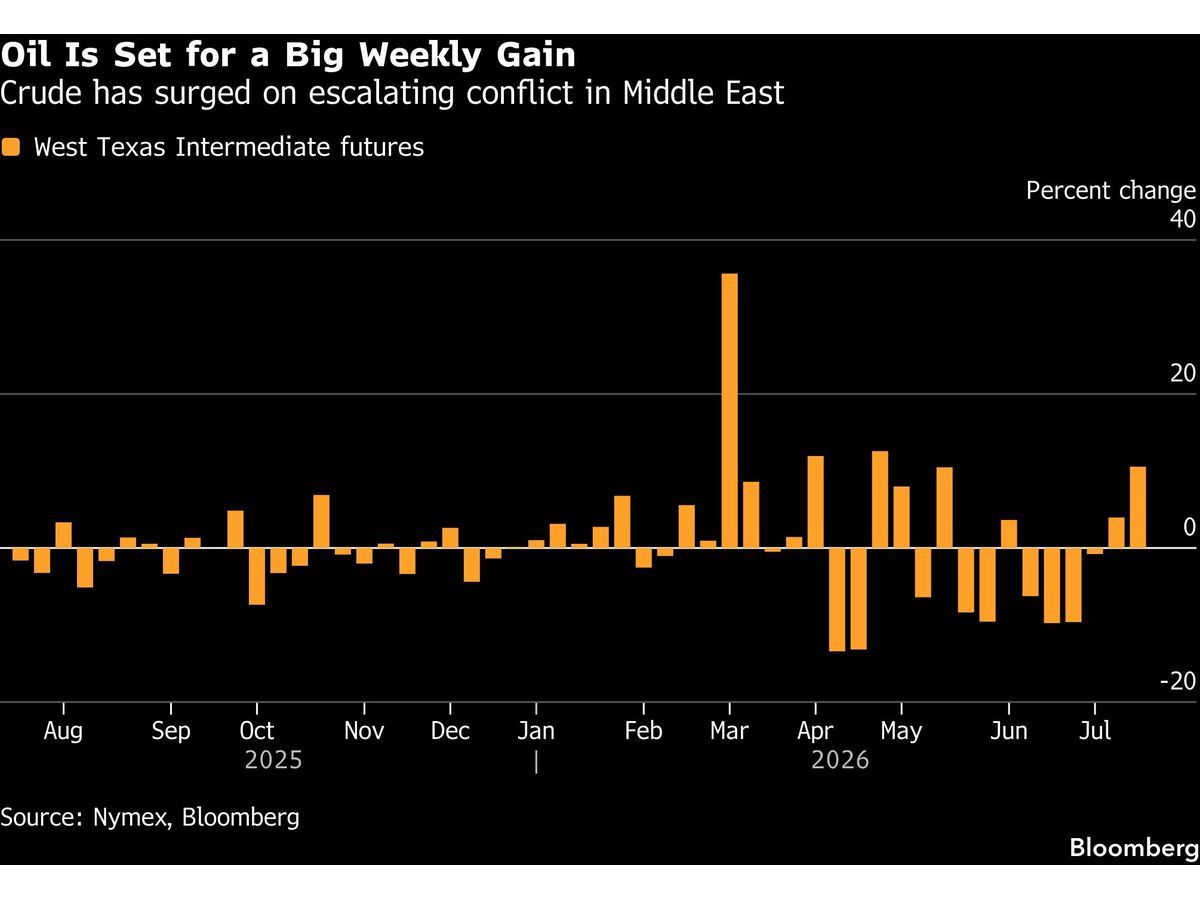
Oil headed for its biggest weekly advance since April as the escalating conflict between the US and Iran disrupted supply from the Middle East.
(Bloomberg) — Oil headed for its biggest weekly advance since April as the escalating conflict between the US and Iran disrupted supply from the Middle East. Global benchmark Brent traded around $85, on track for a weekly gain of about 12%, while West Texas Intermediate rose toward $80 a barrel.
The US carried out another wave of attacks on Iran, hitting targets including defense sites, following the prior night’s strikes that hit an oil tanker near the OPEC member’s main export terminal. Elsewhere in the region, Qatar — a mediator in peace talks — said its armed forces intercepted missiles that targeted the state. Meanwhile, Reuters reported that Tehran had told Yemen’s Houthi rebel group to close the Bab el-Mandeb gateway to the Red Sea — a vital lifeline for Saudi Arabia’s oil exports — if Iranian power infrastructure is targeted.
Crude has soared to near its highest in about a month, paring a roughly 30% decline in the second quarter, as the escalation revives concerns over traffic in the Strait of Hormuz, the chokepoint for about a fifth of global oil flows. The conflict has also impacted the supply of fuels such as diesel and gasoline — sending profit margins for US refiners to records. “Refined products are much more of a squeeze than crude oil,” said Simon Lack, a portfolio manager at the Catalyst Energy Infrastructure Fund.
“We only had that short-term peace when energy executives were warning that we’ve been drawing down inventories, there’s really not a lot of slack left in the system.” Fuel markets in the US and Europe are flashing record tightness, raising the risk of higher costs for consumers already under strain. The squeeze coincides with a plunge in Russian exports after Ukraine attacked the country’s refineries and prompted Moscow to ban diesel exports.
While visible transits through Hormuz have slid, some voyages appear to be continuing, with a handful of tankers conducting ship-to-ship transfers off the coast of Oman. Scrutiny has grown on whether flows through the waterway would continue after Iran targeted vessels that were shuttling barrels out for the United Arab Emirates earlier this week. Meanwhile, two Iran-linked tankers carrying cooking fuel, part of a flotilla transporting the country’s exports, are making repeated U-turns and zigzagging in the Gulf of Oman and the Arabian Sea, as a US naval blockade tightens.
The market focus is shifting from the chance of diplomatic breakthrough to whether oil flow can continue despite persistent security risks, Jorge Leon, senior vice president and head of geopolitical analysis at Rystad Energy AS, said in a note. “The narrow deal remains our base case, but it has become a considerably less comfortable one,” he said. “The question becomes whether the shipping market can adapt to a continuing threat rather than whether the diplomacy can resolve one” when the 60-day negotiation period expires after Aug. 16, he said.
—With assistance from Mia Gindis and Nicholas Lua.
- Published
- Jul 16, 2026
- Updated
- Jul 16, 2026
- Source
- Financial Post
- Category
- Politics
- Read time
- 2 min
Key facts
Why this matters locally
This politics story matters locally because it may affect readers, businesses, commuters, families, or public services in British Columbia.
Local impact
BC Post links this item to British Columbia coverage so readers can follow related city updates, weather, traffic, events, and category news in one place.
Timeline
Source and credit
BC Post may summarize, organize, and add local context for reader clarity. Original reporting remains with the listed publisher.
Related Articles
View all Politics
Powerful pro-life ad featuring boxing legend to air during final World Cup matches
Politics
Powerful pro-life ad featuring boxing legend to air during final World Cup matches
 Politics
Vaughn Palmer: David Eby's slow and expensive step toward involuntary care
Politics
Vaughn Palmer: David Eby's slow and expensive step toward involuntary care
 Politics
Pitt Meadows to host information session for city council candidates
Politics
Pitt Meadows to host information session for city council candidates
 Politics
Hundreds of enthusiatic supporters attend Surrey Mayor Brenda Locke’s fundarising dinner
Politics
Hundreds of enthusiatic supporters attend Surrey Mayor Brenda Locke’s fundarising dinner
 Politics
One hundred affordable housing units for seniors coming to Sherbrooke
Politics
One hundred affordable housing units for seniors coming to Sherbrooke
 Politics
‘No consequences’: East Van woman says she was targeted by hate-motivated assault
Politics
‘No consequences’: East Van woman says she was targeted by hate-motivated assault
More Local Coverage
Latest news Business
AI Market Trends: Q2 2026 Review and Forecast
Business
AI Market Trends: Q2 2026 Review and Forecast
 Local News
Cowichan sports shorts: rugby, hockey, biking
Local News
Cowichan sports shorts: rugby, hockey, biking