

'This has got the local community support of the municipality ... people should feel protected'
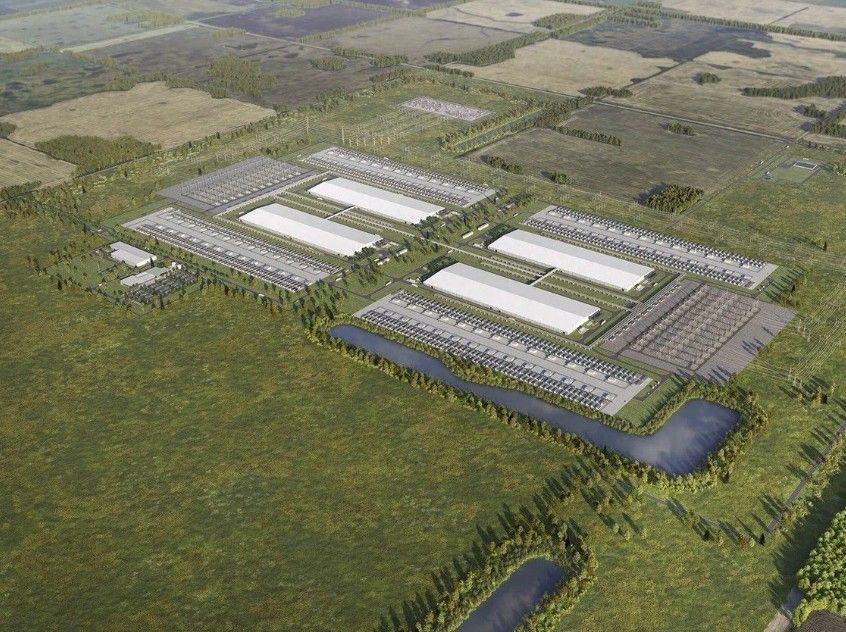
Stateside, there is at least one concerning headline involving the newest player on Alberta’s AI data center frontier — Meta/Facebook’s $13-billion hyperscaler in a part of rural Sturgeon County’s long zoned heavy industrial complex, a plan announced this week and warmly received by local leaders. But construction on a Meta data centre in Cheyenne, Wyoming, thudded to a halt when Cupriavidus gilardii, a fairly alarming, naturally-occurring bacteria, was found in waste water from the site, which was reportedly traced to a Meta contractor.
Now contained with no current positive tests of the bacteria, the incident was taken seriously, Meta vice president of data centre strategy and development Gary Demasi told Postmedia on Friday. “One of our contractors there was asked about potential bacterial contamination,” said Demasi. “It was actually into the wastewater system in the community, and I think there was an association back to the contractor that works for Meta.
I will say that we work very closely with our contractor to make sure that they provide all the data and information to the community that they’re requesting, and we certainly support them in those efforts. “But that’s a reflection of the fact that we are a very responsible corporate citizen, and so we’re we’re cooperating as much as we can to help investigate that situation and rectify it,” Demasi said. Premiere Smith goes to bat On the airwaves Saturday, Premier Danielle Smith went to bat for the Meta project her “concierge team” has been wooing to Alberta for two years, after the Pembina Institute bashed the plan with a news release appealing to the broadest base possible, looking to impale the project on the twin horns of economic and ecological dilemmas.
The institute’s electricity program director David Pickup cited Prime Minister Mark Carney’s Liberal government ambition to triple LNG exports in a decade as triggering market competition, which he envisioned driving energy costs up in Alberta and locking in demand for Alberta’s abundant natural gas with the province’s BYOG (“Bring Your Own Generation”) rules for data centres. “Developers like Meta are effectively forced to choose gas-fired generation, rather than allowing them to choose a combination of technologies to power their operations,” said Pickup. On CHED radio’s regular Saturday Your Province, Your Premier, address Smith said Pembina has been trying to shut down Alberta’s fossil fuel industry for years — as has the NDP, and former Prime Minister Justin Trudeau.
“Finally, after 18 months, we’ve turned the page on that kind of attitude that has created a lot of division in Alberta and a lot of division in the country. So I think folks need to understand that what this is doing is it’s turning our natural gas into a digital refinery. Everyone has always said, ‘Why don’t we do more value-added close to home?
Why don’t we upgrade our resources locally?’ “This is upgrading our natural gas into zeros and ones, which are incredibly valuable because anyone who uses a ChatGPT or Gemini or Claude, anyone who creates a digital image or a video using AI, those are the reasons why there’s such demand,” Smith said. Yes, she freely admits, Alberta uses fossil fuels to fuel the economy.
“Ninety per cent of our electricity is fossil fuel. A hundred per cent of our heating is fossil fuel. Almost 100 per cent of our gasoline is fossil fuel, and that’s the bigger fight that we have to fight,” she told listeners.
In response to a caller who did not feel “protected,” Smith said some people are driven to social media, looking at the worst case scenarios happening in other jurisdictions. “And guess what? So have we.
We did the same thing for the last two years. We wanted to make sure that we weren’t going to end up with the same problems. So, with the Sturgeon one, I feel very confident that not only will it not impact power prices, it’ll bring them down because they’re hooked to the grid initially.
They have to pay their portion of transmission costs, and ...as a result, that’ll cause all of our transmission charges to go down by six per cent,” Smith said, adding that at a minimum, the complex will bring in $250 million tax bucks each year and that the Alberta industrial heartland is well-prepared, long earmarked for 12 refineries. “This has got the local community support of the municipality ... people should feel protected,” Smith said. Good neighbours At the “if you build it, they will come” construction site on Highway 825, Greenlight’s gas-fired combined-cycle plant is already under rain-soaked construction on a quarter-section, a separate project by Meta’s joint venture partners Pembina and Kineticor, who bought the larger data centre land before reselling it to Meta.
The prospective — and essential — forerunner to Meta’s digital mega-brain, Greenlight is expected to generate enough gas-fired combined-cycle electricity to power Edmonton, from electric buses to nursery monitors. The power plant feed into the AESO electric grid is to indirectly supply Meta. Demasi further described Meta’s “good neighbours” policy to Postmedia.
“We partner very closely with electric utilities, the grid operators, the folks who will be supplying energy to the facility to understand what impacts, if any, our facility will have on the grid. If new generation is required, if any kinds of upgrades are required, we pay all of the costs of those upgrades, and in particular, we make sure that other ratepayers are not impacted, and so we’re very careful to partner closely with our electric utilities to ensure that that’s the case,” he said. “We’re very conscious of any kinds of impacts on the environment.
Obviously, we look at, in particular, following all local codes. We at least meet or exceed all local codes when it comes to noise emissions.” Meta works with water utilities to understand impact on local infrastructure, he said.
“We make sure that if there are upgrades required, that we pay all the costs of those upgrades ourselves, and that other ratepayers are not impacted,” he said, touting the closed-loop liquid cooling system as using “very little water over time.” The official numbers are 60 cubic metres of water a day — which is indeed a bit less water than a typical Alberta golf course glugs down — with the rest of the facility cooled with dry coolers, with a smattering of “operational water “ for kitchens, bathrooms, fire protection and maintenance.
- Published
- Jul 11, 2026
- Updated
- Jul 11, 2026
- Source
- Edmonton Journal
- Category
- Politics
- Read time
- 5 min
Key facts
Why this matters locally
This politics story matters locally because it may affect readers, businesses, commuters, families, or public services in British Columbia.
Local impact
BC Post links this item to British Columbia coverage so readers can follow related city updates, weather, traffic, events, and category news in one place.
Timeline
Source and credit
BC Post may summarize, organize, and add local context for reader clarity. Original reporting remains with the listed publisher.
Related Articles
View all Politics
Powerful pro-life ad featuring boxing legend to air during final World Cup matches
Politics
Powerful pro-life ad featuring boxing legend to air during final World Cup matches
 Politics
Vaughn Palmer: David Eby's slow and expensive step toward involuntary care
Politics
Vaughn Palmer: David Eby's slow and expensive step toward involuntary care
 Politics
Corus rebuts misinformation about future of Global News in Alberta after layoffs
Politics
Corus rebuts misinformation about future of Global News in Alberta after layoffs
 Politics
Pitt Meadows to host information session for city council candidates
Politics
Pitt Meadows to host information session for city council candidates
 Politics
Traditional Catholic response to Cupich’s suicide distortion
Politics
Traditional Catholic response to Cupich’s suicide distortion
 Politics
‘No consequences’: East Van woman says she was targeted by hate-motivated assault
Politics
‘No consequences’: East Van woman says she was targeted by hate-motivated assault
More Local Coverage
Latest news Business
AI Market Trends: Q2 2026 Review and Forecast
Business
AI Market Trends: Q2 2026 Review and Forecast
 Local News
Cowichan sports shorts: rugby, hockey, biking
Local News
Cowichan sports shorts: rugby, hockey, biking